
For many international patients who come to Istanbul for treatment, recovery isn’t just about being in the hospital. The city has amazing cultural experiences that go well with the health tourism trip. The Basilica Cistern is one of the most captivating places to visit on a leisurely day out. It’s a huge underground reservoir that shows how smart the Byzantine Empire was at building things, particularly in terms of their advanced engineering techniques and ability to manage the water supply for the city.
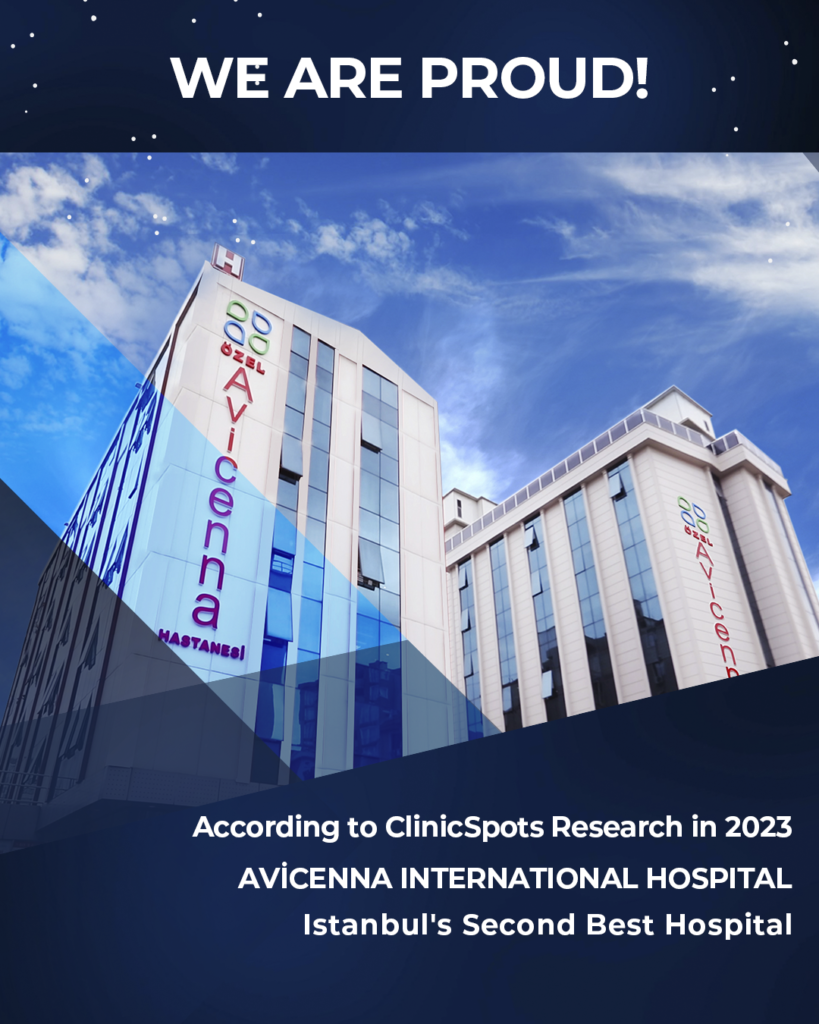
The Basilica Cistern is in the historic Sultanahmet district and is a peaceful, atmospheric place that is excellent for light sightseeing while you’re in town for medical reasons. It has cool underground rooms, softly lit columns, and quiet wooden walkways that make it feel both historical and healing. The Basilica Cistern is a culturally enriching but physically manageable trip for patients who come to Istanbul for treatment at Avicenna International Hospital.
The Historical Origins of the Basilica Cistern
The Basilica Cistern is the biggest underground water storage tank that is still standing from the Byzantine period. Emperor Justinian ordered the building in the 6th century to help with water shortages in Constantinople, especially during the dry summer months. The reservoir was built to hold extra water that was brought in by a complicated system of aqueducts that ran about 20 kilometers from reservoirs near the Black Sea.
The cistern is below what used to be the Stoa Basilica, which was an important public square in ancient Constantinople near the city’s administrative center. This square had libraries, legal courts, and schools, which made the area around it one of the most intellectually active parts of the Byzantine capital.
At its busiest time, the cistern provided water to the Great Palace and other buildings nearby. Byzantine rulers gradually withdrew from the palace complex, leading to the reservoir’s disuse and subsequent neglect by city officials.
It was found again in the 16th century in a very strange way. French scholar Petrus Gyllius heard from people who lived nearby that they could lower buckets through their basements to get water and sometimes catch fish. Gyllius was interested in these stories, so he went around the neighborhood and eventually found the hidden room, which is one of Istanbul’s most amazing buildings.
Architectural Grandeur Beneath the City
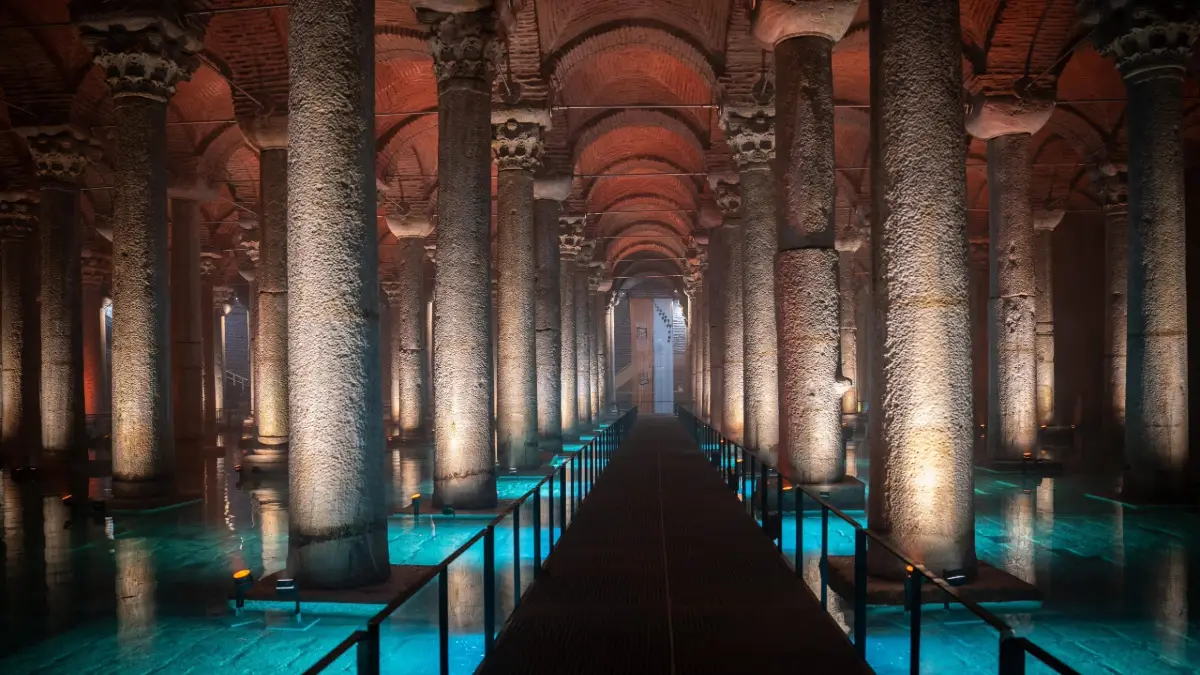
The Basilica Cistern is enormous. The rectangular room is about 143 meters long and 65 meters wide, which is about the size of an underground cathedral. The space was made to hold about 80,000 cubic meters of water, which was a lot for the imperial city.
There are 336 marble columns that hold up the vaulted brick ceiling. They are arranged in 12 rows of 28 columns each. Each column is about 9 meters tall and is spaced out evenly to make a symmetrical forest of pillars that goes deep into the reservoir’s dimly lit depths.
Many of these columns were taken from older Roman temples and buildings, which is why their capitals are different. Visitors can see both Corinthian and Ionic styles, which show how Byzantine builders reused classical architectural elements.
A special waterproof hydraulic plaster was used to cover the walls, making sure that the building could hold water without leaking. The brick vaults above are arranged in concentric patterns that spread the weight evenly across the walls and columns. This design shows how smart the engineers were for the time.
Today, people can safely explore the cistern by walking on raised wooden platforms that keep the shallow water below.
From Forgotten Reservoir to Iconic Landmark
The Basilica Cistern was still there after the Ottomans took over Constantinople in 1453, but it was mostly ignored. Locally, the building is called Yerebatan Sarayı, which means “Sunken Palace.” It wasn’t treated with the respect its history deserved, as it was often neglected and used as a dumping ground for unwanted items. For a while, it was even a place to throw away things you didn’t want, reflecting the neglect and lack of appreciation for its historical significance during that time.
Only in the late 20th century did major restoration work begin. The Istanbul Metropolitan Municipality started a big cleaning and renovation project in 1985. They took away thousands of tons of mud, put in walkways, and added lighting systems to show off the building’s amazing architecture.
In 1987, the cistern opened to the public and quickly became one of Istanbul’s most atmospheric historical sites. It now welcomes visitors from all over the world and shows them what life was like in the Byzantine era.
Unique Details Visitors Should Not Miss
Exploring the Basilica Cistern reveals several distinctive features that capture the imagination.
The Medusa Head Columns
Two amazing stone blocks with the face of Medusa, a mythological figure from Greek mythology whose gaze could turn people to stone, are at the far end of the cistern. These sculptures were used again as bases for columns during construction.
One Medusa head is turned to the side, and the other is turned upside down. Historians think that this orientation may have been done on purpose to take away the figure’s mythical powers. We don’t know where they came from, but they probably came from a building from the time of the Romans.
The “Tear Column”
Another important pillar has detailed carvings that look like drops of water or peacock feathers. People often call it the Tear Column because it is thought to honor workers who died while building it or to show sadness about events from the past.
Carp Swimming Beneath the Walkways
Visitors can see schools of carp slowly swimming through the reflections of the lit-up columns in the shallow water below the platforms. The mix of water, stone, and soft light makes for a peaceful atmosphere that many travelers find surprisingly calming.
Cultural Significance and Film Appearances
The mysterious atmosphere of the Basilica Cistern has drawn writers and filmmakers for decades. From Russia with Love, a James Bond movie from 1963, filmed a dramatic rowing scene among the columns, which brought the area to the attention of people all over the world.
The cistern was also important in Dan Brown’s thriller Inferno, where the last scene takes place in the huge chamber.
These events have made the site even more famous as one of Istanbul’s most unique historical places.
Visiting the Basilica Cistern During Medical Travel
Patients who go to Istanbul for medical care often need to be able to handle and enjoy sightseeing. The Basilica Cistern is a great place to go for these kinds of visits.
Important practical details are:
- In the old Sultanahmet district
- You can walk to Hagia Sophia and the Blue Mosque from here.
- Every day from 9:00 AM to 6:30 PM
- Visits in the evening are available from 7:30 PM to 10:00 PM.
- It’s pretty easy to get around on elevated walkways.
The cistern can be very comfortable in the summer because it is cool and shady. Patients recovering from certain treatments may find it a suitable cultural outing. It requires minimal physical effort. However, visitors should always follow their healthcare provider’s advice about activity levels during recovery.
Istanbul’s Historic Sites and the Health Tourism Experience
In Istanbul, health tourism often includes both world-class medical care and cultural exploration. Patients from abroad often choose the city for its advanced healthcare and rich history.
You can see thousands of years of history at places like the Basilica Cistern while still taking your time. Visitors can think about how smart ancient engineers were while walking through its lit-up rooms. They can also take a break from the busy streets above.
For many medical tourists, these kinds of experiences are the best parts of their time in Turkey.
Conclusion
The Basilica Cistern is one of the most impressive buildings in Istanbul. It is an underground monument that shows how skilled and ambitious the Byzantine Empire was at building things. Its tall columns, captivating lighting, and long history make it a great place for people who are visiting the city to see.
For international patients travelling to Istanbul for treatment, gentle cultural excursions can enhance both emotional wellbeing and overall recovery by providing a sense of connection to the local culture and history, which can alleviate stress and promote a positive healing environment. Institutions such as Avicenna International Hospital support this holistic perspective on medical travel, recognizing that experiencing the city’s history and atmosphere can be an enriching part of the patient journey.
The Basilica Cistern is well-known for being the largest remaining underground water reservoir from the Byzantine Empire in Istanbul. It has 336 marble columns, atmospheric lighting, and strange Medusa head sculptures.
The cistern was built and expanded during the reign of Emperor Justinian I in 537 AD. However, there were already water storage structures on the site during the reign of Constantine in the 4th century.
Yes. Many people think the Basilica Cistern is one of the most interesting historical sites in Istanbul. Its dramatic underground architecture, cool atmosphere, and central location in Sultanahmet make it a wonderful cultural spot for tourists.