

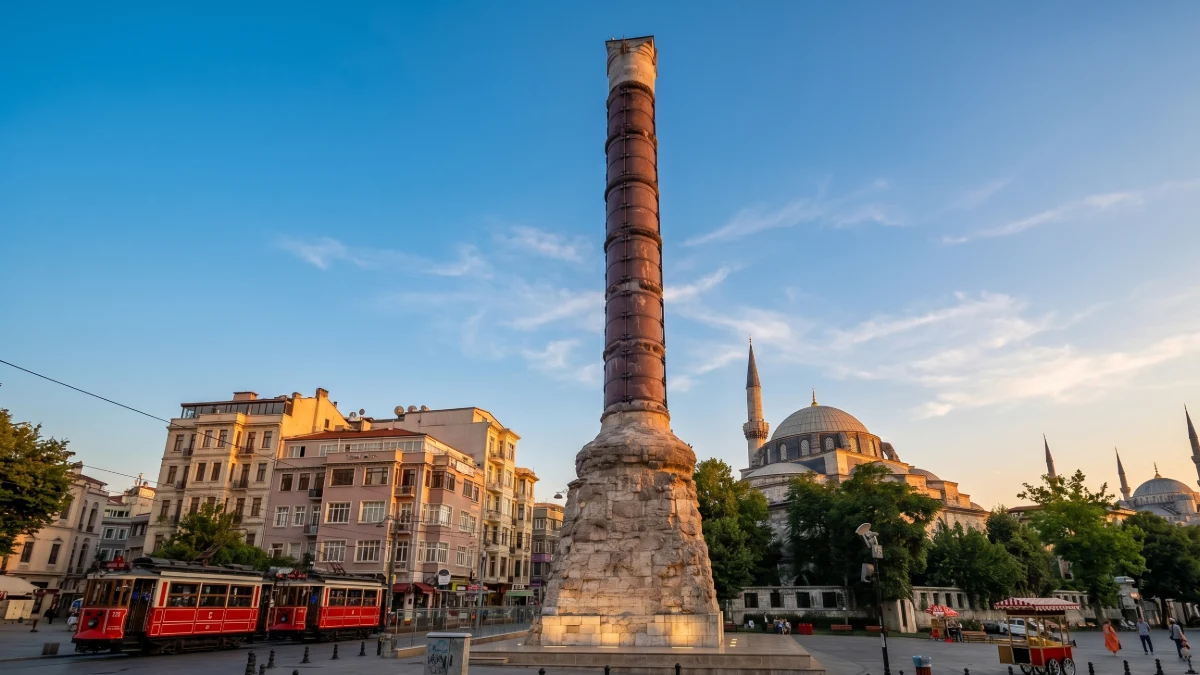
The Column of Constantine is one of the oldest surviving monuments from the Roman era in Istanbul and a powerful reminder of the city’s transformation into the capital of a vast empire. Standing proudly in the historic Çemberlitaş district, this remarkable structure has witnessed nearly seventeen centuries of political change, religious evolution, earthquakes, fires, and restoration efforts.
For visitors exploring Istanbul today, the monument offers far more than a glimpse into ancient history. It provides a direct connection to the foundations of the city once known as Constantinople and remains an essential stop for travelers interested in Roman, Byzantine, and Ottoman heritage.
What Is the Column of Constantine?
The Column of Constantine Istanbul is a monumental Roman column commissioned by Emperor Constantine the Great to commemorate the establishment of Constantinople as the new capital of the Roman Empire.
Dedicated in 330 AD, the monument originally stood at the center of the famous Forum of Constantine, one of the most important public squares in the ancient city. It served as both a political symbol and a visual statement of imperial authority during a period that reshaped the history of Europe and the Eastern Mediterranean.
Today, although the surrounding forum has disappeared beneath centuries of urban development, the column remains one of the few surviving structures directly connected to Constantinople’s founding.
When Was the Column of Constantine Built?
A common question among visitors is: When was the Column of Constantine built?
The monument was erected around 328 AD and officially dedicated in 330 AD during the ceremonies marking Constantinople’s inauguration as the new imperial capital.
Its construction represented Constantine’s ambition to create a “New Rome” that would become the administrative and cultural center of the Eastern Roman Empire. The column quickly became one of the city’s most recognizable landmarks and was frequently included among the wonders of Constantinople.
Why Is the Column So Important?
The Column of Constantine is important because it is the oldest surviving Constantinian monument in Istanbul.
Beyond its age, the structure symbolizes several major historical transitions:
- The rise of Constantinople as an imperial capital
- The transformation of Roman political power
- The coexistence of pagan and Christian traditions
- The continuity of urban life in Istanbul across nearly two millennia
For historians, the monument provides valuable evidence of how emperors used architecture and public spaces to communicate power, legitimacy, and religious identity.
The Forum of Constantine: The Heart of Ancient Constantinople
The Forum of Constantine was once among the busiest locations in the city.
Located along the ancient Mese, Constantinople’s main ceremonial avenue, the circular forum was surrounded by colonnades, public buildings, shops, and monuments. At its center stood the enormous porphyry column that dominated the skyline.
The forum functioned as the following:
- A gathering place for citizens
- A ceremonial space for imperial celebrations
- A commercial centre
- A political landmark
Although little of the forum survives today, understanding its role helps visitors appreciate the column’s original significance. What appears today as a solitary monument was once the focal point of a grand imperial square.
What Makes the Column Unique?
The column was constructed from massive blocks of deep-purple porphyry stone, a material highly prized in the Roman world.
Porphyry was quarried in Egypt and reserved almost exclusively for imperial use. Its rich purple color symbolized power, prestige, and royal authority.
Today the column rises approximately 34.8 meters above street level, although historians believe it was originally much taller. The monument once reached close to 50 meters when its upper elements and statue were intact.
Another distinctive feature is the series of metal rings wrapped around the stone drums. These iron hoops gave the monument its Turkish name, Çemberlitaş, meaning “Hooped Stone.”
The Lost Statue on Top
The summit originally supported a colossal bronze statue of Constantine.
Historical accounts describe the emperor portrayed in the image of the sun god, reflecting the complex religious environment of the fourth century. The statue reportedly wore a radiant crown and overlooked the growing city below.
A violent storm in the early twelfth century caused the statue to collapse, along with several upper sections of the column.
Later Byzantine rulers repaired the monument and added a large Christian cross to its summit. Following the Ottoman conquest of Constantinople in 1453, the cross was removed.
These changes illustrate how the monument adapted to shifting religious and political realities over the centuries.
Inside the Column of Constantine: Legends and Sacred Relics
Many visitors wonder about Inside the Column of Constantine and whether hidden chambers exist beneath it.
According to longstanding legends, a chamber beneath the monument contained sacred relics collected by Constantine. Historical traditions claim these relics included the following:
- Fragments of the True Cross
- The Palladium associated with ancient Troy
- Objects linked to biblical figures such as Noah and Moses
- Sacred Christian artefacts
While archaeological evidence remains limited, these stories contributed greatly to the monument’s mystique throughout Byzantine history.
Whether fact or legend, the tales reveal the symbolic importance the column held for generations of Constantinople’s inhabitants.
Why Is It Called the Burnt Column?
The monument is also known as the Burnt Column.
A devastating fire in the eighteenth century blackened portions of the porphyry stone, leaving visible marks that contributed to this nickname. Despite suffering repeated damage from fires, earthquakes, and invasions, the structure never completely collapsed.
Extensive restoration efforts have taken place over the centuries, including major conservation work during the twentieth and twenty-first centuries.
Its survival is a testament to both Roman engineering and continued preservation efforts in modern Istanbul.
What Can Visitors See Nearby?
The Column of Constantine sits within one of Istanbul’s most historic districts.
Visitors can easily combine their visit with nearby attractions, including:
- Grand Bazaar
- Hagia Sophia
- Blue Mosque
- Basilica Cistern
- Çemberlitaş Hamamı
- Nuruosmaniye Mosque
The location is especially convenient because it lies directly along the historic route that connected many of Constantinople’s most important monuments.
How Do You Get to the Column of Constantine?
The easiest way to reach the monument is by using Istanbul’s T1 tram line.
Visitors should simply exit at Çemberlitaş Station, which is located immediately beside the column. The site is freely accessible throughout the day and can easily be included within a walking tour of the Historic Peninsula.
Its central location makes it one of the most accessible Roman monuments in the city.
The Column of Constantine and Health Tourism in Istanbul
For international patients visiting Istanbul, historical sites can provide enriching experiences before treatment or during recovery periods when approved by their healthcare team.
The Column of Constantine offers a gentle and culturally rewarding visit that requires minimal physical exertion while allowing visitors to explore nearly 1,700 years of history. Combined with nearby museums, traditional Turkish baths, architectural landmarks, and pedestrian-friendly streets, the area contributes to Istanbul’s unique appeal as a destination where healthcare and cultural discovery coexist.
Patients often appreciate opportunities to connect with the city’s heritage while experiencing the broader atmosphere that makes Istanbul one of the world’s leading health tourism destinations.
Conclusion
The Column of Constantine remains one of Istanbul’s most remarkable surviving Roman monuments. From its origins in the Forum of Constantine to the legends surrounding hidden relics and lost imperial statues, the structure continues to tell the story of a city that shaped world history. For travelers interested in Roman heritage, Byzantine culture, and the foundations of modern Istanbul, a visit to this iconic monument offers an unforgettable glimpse into the past.
Choosing the right treatment starts with access to accurate information and experienced medical professionals. At Avicenna International Hospital, we support international patients with personalized healthcare in Turkey.
Yes, the Column of Constantine is completely free to visit. It stands in a public square and can be viewed at any time while exploring Istanbul’s Historic Peninsula.
Çemberlitaş means “Hooped Stone” in Turkish. The name comes from the iron bands wrapped around the column to reinforce the ancient porphyry blocks.
Historical traditions say there was a chamber containing sacred relics beneath the monument. While these stories remain an important part of the column’s history, many details are still debated by historians and archaeologists.