

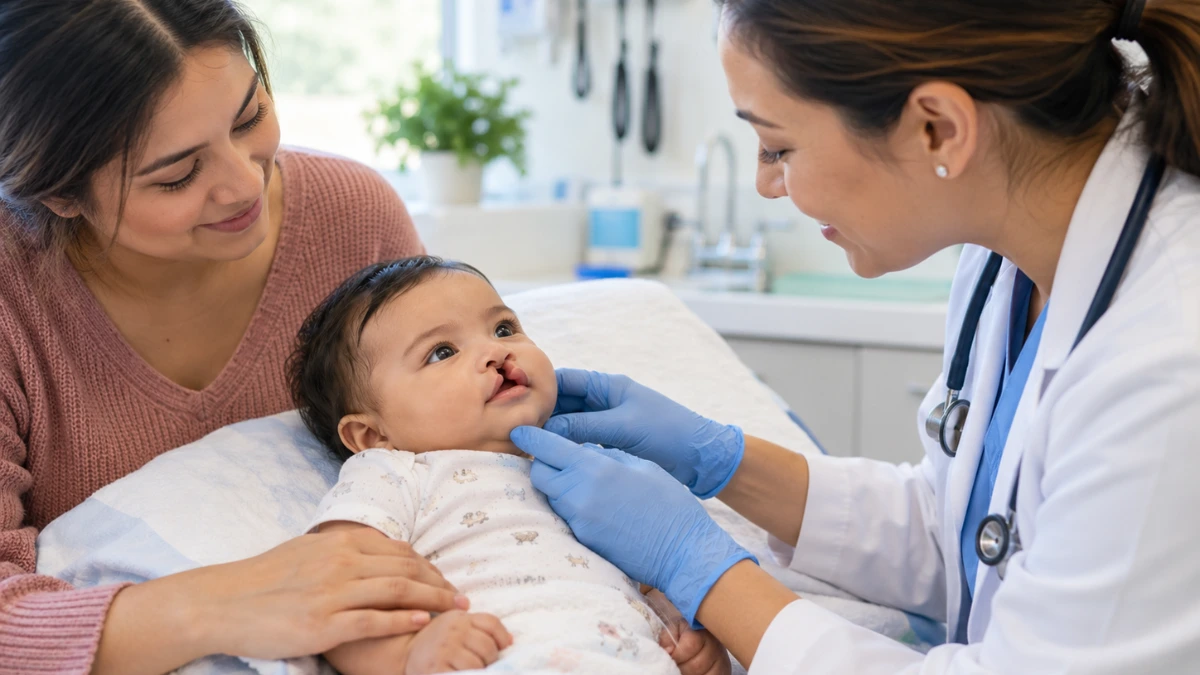
Cleft lip surgery is a reconstructive operation that brings the separated tissues of the upper lip together, repairs the underlying lip muscles and improves the shape and function of the lip.
Some babies have a small cleft affecting part of the upper lip. Others have a wider opening that extends toward the nose, and some also have a cleft palate.
For parents, understanding when surgery should take place, how the repair is performed and what happens afterward is an important part of preparing for treatment.
The exact timing and surgical plan depend on the baby’s health, growth, cleft anatomy and whether other structures are affected.
When Is Cleft Lip Surgery Usually Performed?
For many otherwise healthy babies, cleft lip repair is planned at around 3 to 6 months of age.
However, age alone does not determine when surgery should take place.
The surgical and pediatric teams may also consider:
- Weight gain and nutritional status
- Feeding ability
- Prematurity
- General health
- Respiratory or cardiac conditions
- Other congenital conditions
- Type and extent of the cleft
- Suitability for general anesthesia
A baby who was born prematurely or has additional medical problems may require surgery at a different time.
Parents should seek specialist assessment early rather than waiting until the expected surgical age before beginning the process.
What Is Cleft Lip Surgery?
A cleft lip develops when the tissues that form the upper lip do not join completely during early pregnancy.
It may affect one side of the lip, both sides or only part of the upper lip.
Cleft lip repair, also called cheiloplasty, reconstructs these separated tissues.
The operation aims to close the opening, restore continuity of the upper lip and reconstruct the orbicularis oris muscle, which surrounds the mouth.
The surgeon also works to improve lip movement, the shape of the Cupid’s bow and the relationship between the lip and nose.
The procedure is therefore not simply cosmetic closure of the visible gap.
Reconstruction of the deeper muscle and tissue relationships is an important part of restoring lip form and function.
What Types of Cleft Lip Can Be Repaired?
Cleft lips vary in width, position and anatomical involvement.
| Type | What it means |
|---|---|
| Unilateral cleft lip | The cleft affects one side of the upper lip |
| Bilateral cleft lip | The cleft affects both sides |
| Incomplete cleft lip | The opening extends only partway toward the nose |
| Complete cleft lip | The cleft extends through the upper lip toward the nostril |
| Cleft lip with cleft palate | Both the lip and the roof of the mouth are affected |
A wider cleft may require more complex planning, but width alone does not determine the eventual result.
The surgeon also evaluates the nasal base, lip muscles, nostrils, gum ridge and palate.
The visible opening may represent only part of the underlying anatomical difference.
Cleft Lip vs Cleft Palate: What Is the Difference?
Cleft lip and cleft palate are related conditions, but they affect different structures.
A cleft lip involves the upper lip and may also affect the nose and gum ridge.
A cleft palate is an opening in the roof of the mouth that creates an abnormal connection between the oral and nasal cavities.
| Feature | Cleft Lip | Cleft Palate |
|---|---|---|
| Main area | Upper lip | Roof of the mouth |
| Surgical goal | Reconstruct lip tissue and muscles | Close the palate and reconstruct palatal muscles |
| Typical timing | Often around 3–6 months | Usually later in infancy |
| Main functional concerns | Lip continuity, feeding seal and nasal form | Feeding, speech and middle-ear health |
| Long-term follow-up | Lip and nasal development | Speech, hearing, dental and facial development |
If a baby has both conditions, repairing the lip does not repair the palate.
The procedures are usually planned as separate parts of a longer treatment pathway.
Families should understand which structures are affected before assuming that one operation will complete treatment.
What Happens Before Cleft Lip Surgery?
Preoperative assessment focuses on both the cleft anatomy and the baby’s overall health.
The medical team may examine the upper lip, nose, gum ridge and palate while reviewing feeding ability, weight gain and medical history.
A pediatric and anesthesia assessment is generally required before surgery.
Feeding and Weight Gain
Some babies with an isolated cleft lip are able to feed relatively well.
Feeding may be more difficult when a cleft palate is also present because the baby may struggle to generate adequate suction.
Depending on the child’s needs, feeding support may involve positioning advice, expressed breast milk, specialized bottles or modified nipples.
Poor weight gain should be addressed before surgery because nutritional status is important for anesthesia and wound healing.
Is Presurgical Molding Always Necessary?
No.
Some babies with wider or more complex clefts may be considered for lip taping or nasoalveolar molding (NAM).
These techniques aim to improve the position of selected lip, gum or nasal structures before surgery.
They are not required for every child, and availability differs between treatment centers.
When recommended, molding may require repeated appointments over several weeks.
Families traveling internationally should ask whether presurgical treatment is needed before arranging travel dates.
How Is Cleft Lip Surgery Performed?
Cleft lip repair is performed under general anesthesia.
The technique depends on the type of cleft, its width and the position of the surrounding tissues.
Although surgical approaches vary, several principles are common.
Repositioning the Lip Tissues
The surgeon carefully designs the incisions and rearranges tissue to reconstruct the upper lip.
Attention is given to the alignment of the skin, red border of the lip, inner lining and natural lip landmarks.
Repairing the Lip Muscle
Reconstruction of the orbicularis oris muscle is an essential part of the operation.
In a cleft lip, the muscle may be separated or attached abnormally.
Restoring muscle continuity helps support lip movement, function and upper-lip shape.
Restoring Lip Shape
The surgeon works to create a more balanced upper-lip contour.
This includes the Cupid’s bow, lip height and the relationship between the two sides.
The objective is improved balance and function rather than mathematically perfect symmetry.
Addressing Nasal Differences
Cleft lip can also affect nostril shape, the nasal base and cartilage position.
Selected nasal corrections may be performed during the initial lip repair.
However, not every nasal difference can or should be fully corrected during infancy.
Some concerns may need reassessment as the child grows.
Closing the Repair
The reconstructed tissues are closed with sutures.
After surgery, the baby is monitored while recovering from anesthesia. The medical team assesses breathing, comfort, feeding, hydration and the surgical wound.
Will Cleft Lip Surgery Correct the Nose?
It may improve nasal shape, but complete or permanent symmetry cannot be guaranteed.
The lip and nose develop closely together, so a cleft lip can affect nostril width, nasal base position and cartilage alignment.
Some correction may be included in the first operation.
However, facial growth continues for many years. As the child develops, residual nasal asymmetry or breathing concerns may become more noticeable.
Some children later need additional nasal assessment or surgery.
Parents should ask whether nasal correction is included in the initial repair and what further treatment may be needed during growth.
What Is Recovery Like After Cleft Lip Surgery?
Temporary swelling, redness and tenderness around the upper lip are common after surgery.
Some babies may be unsettled or temporarily less comfortable during feeding.
Early recovery focuses on:
- Adequate feeding and hydration
- Pain control
- Protecting the repaired lip
- Wound care
- Monitoring for bleeding or infection
- Attending follow-up appointments
Hospital observation varies depending on the child’s health, the extent of surgery and recovery from anesthesia.
The surgical team should explain whether the stitches dissolve or need to be removed.
Initial wound healing takes place over the following weeks, but lip shape and scar appearance continue to change for much longer.
Parents should follow the treating team’s instructions rather than applying wound products or scar treatments independently.
How Should a Baby Be Fed After Cleft Lip Repair?
Feeding instructions vary between surgical teams and should be followed carefully.
Some babies can continue their previous feeding method. Others may temporarily need modified feeding to reduce pressure on the repaired lip.
Before leaving the hospital, parents should understand which feeding method is permitted, how often the baby should feed and how to protect the surgical area.
They should also know how to monitor fluid intake and recognize signs of dehydration.
If a cleft palate is present, feeding requirements may be different.
A baby who cannot take enough fluids, repeatedly vomits, has difficulty breathing or shows signs of dehydration needs prompt medical assessment.
The specific feeding plan should always come from the treating surgical team.
Will There Be a Scar After Cleft Lip Surgery?
Yes.
Cleft lip repair leaves a permanent surgical scar.
The incision is designed as part of the reconstruction so that the scar follows the natural contours of the lip as closely as possible.
During early healing, the scar may appear red, firm, raised or more noticeable than expected.
Its appearance usually changes over time, but it does not disappear completely.
Final scar visibility depends on the original cleft anatomy, surgical technique, skin characteristics and individual healing.
Scar products or treatments should only be started when the surgeon considers the wound sufficiently healed.
Some children may later be assessed for scar revision, although this is not routinely necessary.
What Are the Risks of Cleft Lip Surgery?
Cleft lip repair is an established reconstructive procedure, but it still involves potential risks.
These include:
- Bleeding or infection
- Delayed wound healing
- Partial opening of the repair
- Raised or unfavorable scarring
- Persistent lip or nasal asymmetry
- Changes in lip contour
- Anesthesia-related complications
- Possible need for further corrective surgery
The likelihood of complications depends partly on the child’s health, cleft anatomy and complexity of reconstruction.
Even after successful initial repair, facial growth can change the relationship between the lip, nose and surrounding structures.
Parents should understand both the immediate surgical risks and the importance of long-term follow-up.
Will My Child Need More Surgery Later?
Not necessarily, but cleft care often continues through childhood.
Some children require only the primary lip repair. Others may later need treatment for residual lip asymmetry, scar distortion, nasal differences or functional concerns.
Children with both cleft lip and palate may also require palate surgery, hearing assessment, speech-language therapy, dental treatment or orthodontics.
A cleft involving the gum ridge may eventually require additional treatment, including an alveolar bone graft.
Whether further surgery is needed should be determined through ongoing specialist assessment.
Cleft lip repair is one part of treatment, not necessarily the end of the child’s cleft-care pathway.
Does Cleft Lip Surgery Improve Speech?
Cleft lip repair restores lip structure and muscle continuity, supporting lip movement involved in producing certain speech sounds.
However, speech depends on much more than the upper lip.
Children with an associated cleft palate may experience speech difficulties related to palatal function.
Repairing the lip does not close a cleft palate or guarantee normal speech development.
When appropriate, follow-up may include speech-language assessment, hearing testing, ENT review and additional treatment.
Children with an isolated cleft lip often have different long-term needs from children who also have a cleft palate.
Can Older Children or Adults Have Cleft Lip Surgery?
Yes.
Primary cleft lip repair is usually performed during infancy, but an older child or adult who has never undergone repair can still be evaluated for reconstructive treatment.
Other patients may have already undergone cleft surgery and seek further treatment for lip asymmetry, scars, nasal differences or functional concerns.
These situations require different planning from a baby’s primary repair.
Previous operations, existing scar tissue, current anatomy and facial growth all influence the surgical approach.
Primary cleft repair, scar revision and secondary lip or nasal reconstruction should not be treated as identical procedures.
Planning Cleft Lip Surgery in Turkey
For international families, cleft treatment should be planned as a medical pathway rather than a single isolated operation.
Preliminary assessment may include photographs, the baby’s age, weight, feeding history, medical conditions and previous medical records.
Information about possible palate involvement is particularly important.
However, photographs alone cannot determine whether a child is medically ready for surgery.
Before traveling, parents should clarify:
- Whether the child has cleft lip alone or cleft lip with palate involvement
- Which specialists will be involved
- Whether pediatric and anesthesia assessment is available
- Whether presurgical treatment is required
- The expected procedure and hospital observation plan
- Feeding and wound-care instructions
- Timing of postoperative appointments
- When the child may be medically cleared to travel
- How continuing care will be coordinated after returning home
If future palate repair, hearing monitoring, speech assessment or dental treatment may be necessary, families should understand how those services will be arranged.
Long-term access to appropriate specialists matters as much as planning the first operation.
Cleft Lip Surgery at Avicenna International Hospital
Avicenna International Hospital in Istanbul provides Aesthetic, Plastic and Reconstructive Surgery services. Cleft lip and palate repair is also listed among the procedures in the hospital’s published surgical expertise.
Cleft lip treatment involves reconstructing the lip and its underlying muscles rather than simply correcting the visible opening.
Treatment planning may consider the child’s age, weight, nutritional condition, general health, feeding development, cleft anatomy and possible nasal or palatal involvement.
Avicenna also provides Pediatric Services, while its Maxillofacial Surgery information includes cleft lip and palate reconstruction.
Children with additional cleft-related needs may require assessment and treatment from several specialties.
For international families, medical records and photographs may assist with preliminary review. Final suitability, timing and surgical planning require direct medical assessment.
Families should confirm that the specialists and follow-up services needed for their child’s particular cleft condition can be coordinated before arranging treatment.
Avicenna’s International Patient Services provides information about appointment coordination, language assistance and travel-related support.
Frequently Asked Questions
At What Age Is Cleft Lip Surgery Usually Done?
It is commonly performed around 3–6 months of age. The timing depends on the baby’s health, growth, anatomy and medical assessment.
Is Cleft Lip Surgery Painful for Babies?
The operation is performed under general anesthesia. Postoperative discomfort is managed with pain relief prescribed by the treating team.
How Long Does Cleft Lip Surgery Take?
The duration varies according to the type and complexity of the cleft and whether additional nasal reconstruction is performed. An isolated repair may take approximately one to two hours, but more complex procedures can take longer.
Are Cleft Lip and Cleft Palate Repaired Together?
Usually not. They involve different structures and are commonly repaired at different stages according to the child’s needs.
Can a Baby Feed Normally After Surgery?
Many babies can resume feeding with appropriate support, but the permitted feeding method depends on the procedure and surgical team’s instructions.
Will the Scar Disappear Completely?
No. The scar is permanent, although it generally becomes less noticeable as it matures.
Will the Nose Be Completely Symmetrical?
Not necessarily. Surgery may improve nasal asymmetry, but growth can change nasal appearance over time.
Is One Cleft Lip Operation Always Enough?
No. Some children need only the primary lip repair, while others require later lip, nasal or related treatment.
Can Adults Have Cleft Lip Surgery?
Yes. Adults can be assessed for primary repair or secondary reconstructive procedures depending on their anatomy and previous treatment.