
Being over 40 does not automatically make someone too old for LASIK. What changes around this age is the type of vision problem that needs to be considered.
LASIK reshapes the cornea to correct refractive errors such as myopia, hyperopia and astigmatism. It does not stop the natural lens inside the eye from ageing. As that lens gradually becomes less flexible, focusing on nearby objects becomes more difficult. This age-related change is called presbyopia.
For this reason, someone can have good distance vision after LASIK and still need reading glasses for close work.
LASIK After 40: Quick Answer
LASIK can still be an option after 40, but it does not stop presbyopia. Patients may achieve good distance vision and still need reading glasses for near tasks. Some people may be considered for monovision, but suitability depends on corneal health, dry-eye status, natural-lens changes, prescription and individual visual needs.
Can You Have LASIK After 40?
Yes.
There is no single age at which LASIK automatically becomes unsuitable.
For patients over 40, the ophthalmologist may assess:
- Current prescription
- Prescription stability
- Corneal thickness
- Corneal shape
- Corneal topography or tomography
- Tear-film and ocular-surface health
- Natural-lens clarity
- Early cataract changes
- Distance and near-vision needs
- Lifestyle and occupation
- Expectations about glasses after surgery
Two patients of the same age can therefore receive very different recommendations.
What Is Presbyopia?
Presbyopia is the age-related loss of the eye’s ability to focus clearly on nearby objects.
The natural lens inside the eye normally changes shape to focus at different distances. As the lens becomes less flexible with age, near focusing becomes more difficult.
Common signs include:
- Holding a phone farther away
- Difficulty reading small print
- Needing more light for close work
- Eye strain while reading
- Blurred near vision
Presbyopia commonly becomes noticeable during the 40s, although the timing varies between individuals.
Does LASIK Cause Presbyopia?
No.
Presbyopia develops because of age-related changes in the natural lens, whereas LASIK works on the cornea.
However, LASIK can make existing presbyopia more noticeable in some people with myopia.
A nearsighted patient may be able to remove their distance glasses and read comfortably. If LASIK then corrects both eyes for distance, that near-vision advantage may disappear.
The patient may consequently need reading glasses even though LASIK did not cause the presbyopia.
Does LASIK Correct Presbyopia?
Standard LASIK does not restore the natural lens’s ability to focus at different distances.
This distinction is important.
LASIK can correct refractive error by reshaping the cornea, but it does not restore flexibility to the natural lens or prevent age-related changes.
Someone who undergoes LASIK at 42 may therefore experience increasing difficulty with near vision over the following years.
Will I Need Reading Glasses After LASIK?
Possibly.
If both eyes are corrected primarily for distance, a patient with presbyopia may still need reading glasses for:
- Phones
- Books
- Menus
- Small print
- Detailed close work
- Some computer tasks
LASIK after 40 should therefore not be described as a guarantee of complete or permanent independence from glasses.
What Is Monovision LASIK?
Monovision is one strategy that may reduce dependence on reading glasses in selected patients.
Typically:
- One eye is corrected mainly for distance vision
- The other eye is left somewhat more nearsighted for near vision
The brain then learns to use information from the two eyes differently depending on the visual task.
Monovision can increase the functional range of vision, but it also involves a compromise.
Is Monovision Suitable for Everyone?
No.
Some patients adapt well to monovision, while others find the difference between the eyes uncomfortable.
Possible disadvantages include:
- Reduced depth perception
- Less precise binocular vision
- Difficulty adapting
- Reduced visual quality in low light
- Difficulty with visually demanding activities
People who depend heavily on night driving, fine depth perception or precise binocular vision should discuss these requirements before considering monovision.
Why Try Monovision With Contact Lenses First?
A contact-lens trial can allow the patient to experience a similar visual arrangement before making a permanent surgical decision.
During the trial, one eye is corrected mainly for distance and the other more towards near vision.
The patient can then assess how this affects:
- Reading
- Computer use
- Driving
- Night driving
- Watching television
- Using a phone
- Work-related visual tasks
A contact-lens trial cannot reproduce the surgical result perfectly, but it can provide useful information about whether the patient is comfortable with the principle of monovision. Pasted text
Can Both Eyes Be Corrected for Distance?
Yes.
Some patients prefer clear distance vision in both eyes and are comfortable using reading glasses when needed.
This may be preferable for someone who prioritises:
- Driving
- Clear distance vision
- Sports
- Night vision
- Binocular distance vision
The goal should not simply be to avoid glasses at all costs. The patient’s actual visual priorities should guide the plan.
Is 45 Too Old for LASIK?
Not necessarily.
A healthy 45-year-old with a stable prescription, suitable corneal anatomy, a healthy ocular surface and clear natural lenses may still be considered for LASIK.
Another person of the same age may have significant dry eye, abnormal corneal tomography or early lens changes that make another approach more appropriate.
Age alone does not determine suitability.
Can You Have LASIK at 50?
Possibly.
LASIK may still be appropriate for selected patients in their 50s, but the condition of the natural lens becomes increasingly important.
The question is no longer only whether the cornea can be treated.
The ophthalmologist should also consider whether corneal laser surgery is the most appropriate way to address that patient’s current and future visual needs.
If presbyopia is significant or early cataract changes are developing, a lens-based option may sometimes be discussed.
This does not mean that everyone over 50 should have lens surgery.
LASIK vs Lens-Based Surgery
Both LASIK and lens-based procedures treat different structures of the eye.
LASIK reshapes the cornea.
Lens-based surgery removes the natural lens and replaces it with an intraocular lens.
Because presbyopia mainly results from age-related changes in the natural lens, lens surgery addresses a different part of the visual system from LASIK.
However, lens surgery is an intraocular operation with its own risks, limitations and indications. It should not be treated simply as a more advanced version of laser eye surgery.
Does Everyone Over 40 Need Lens Replacement?
No.
Age alone is not a reason to remove a clear natural lens.
For many people in their 40s, the main visual problem may still be myopia, hyperopia or astigmatism, and corneal laser treatment may remain reasonable.
The condition of the natural lens needs to be considered together with the refractive error, corneal findings and the patient’s visual priorities. Pasted text
Does LASIK Prevent Cataracts?
No.
LASIK changes the cornea and does not prevent age-related changes in the natural lens.
A patient who has previously undergone LASIK can still develop cataracts and later have cataract surgery.
Previous refractive surgery should be reported to the cataract surgeon because it can affect calculations used when selecting the intraocular lens.
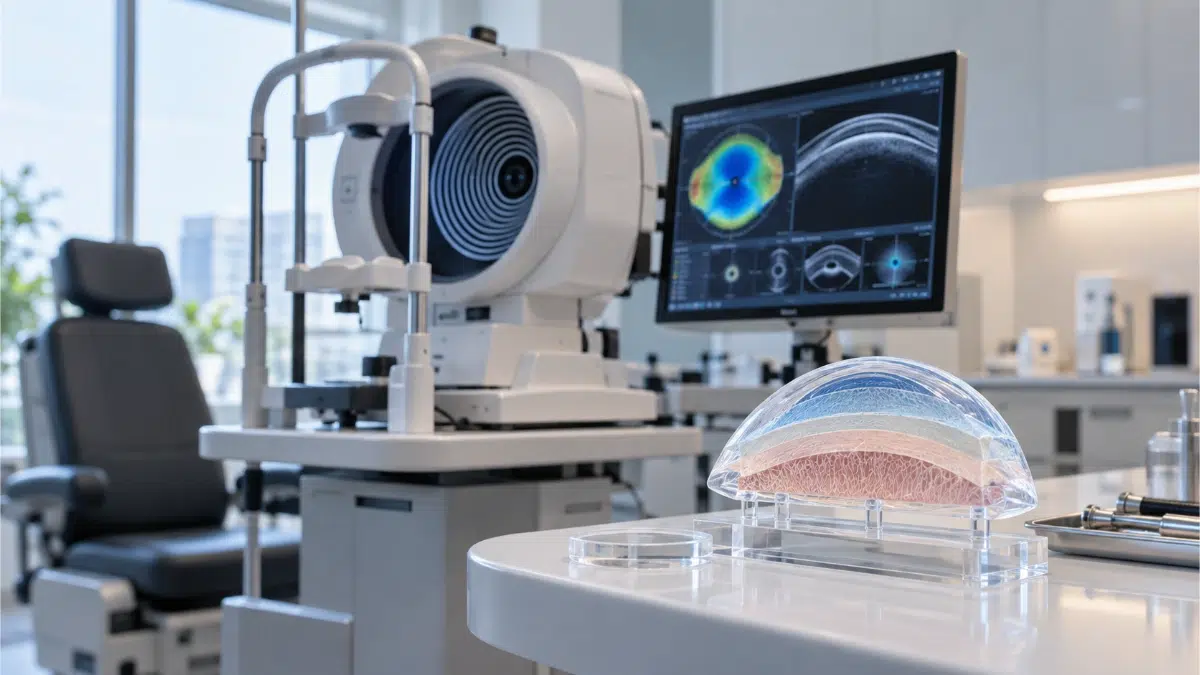
Why Is Corneal Topography Important After 40?
Being over 40 does not reduce the need for careful corneal screening.
Before LASIK, the ophthalmologist may assess:
- Corneal curvature
- Corneal thickness
- Thickness distribution
- Corneal symmetry
- Topography or tomography
- Signs of keratoconus or other ectatic abnormalities
Age and presbyopia may change the treatment strategy, but they do not make unsuitable corneal anatomy acceptable for laser surgery.
Our Corneal Topography Before Laser Eye Surgery guide explains this assessment in more detail.
Does Dry Eye Matter After 40?
Yes.
Dry-eye symptoms can affect comfort, visual quality and the reliability of some refractive measurements.
Patients with symptoms such as burning, grittiness, redness, fluctuating vision or contact-lens intolerance may need ocular-surface assessment before treatment.
Clinically significant dry eye may need to be treated before final measurements are taken.
Our Dry Eye Before LASIK guide explains why tear-film and ocular-surface health matter before refractive surgery.
Can PRK Be Used After 40?
Possibly.
PRK reshapes the cornea without creating a LASIK flap, but the same age-related issues still apply.
PRK does not:
- Stop presbyopia
- Restore natural-lens accommodation
- Prevent cataracts
- Guarantee permanent independence from reading glasses
The choice between LASIK and PRK should therefore still be based on corneal anatomy, ocular-surface health and overall refractive needs.
Our LASIK vs PRK guide explains the differences between these two approaches.
Does No-Touch Laser Prevent Reading Glasses?
No.
No-Touch Laser generally refers to a flap-free surface-laser procedure, but it still treats the cornea.
It does not restore flexibility to the natural lens and therefore cannot stop presbyopia.
A patient may still need reading glasses as near focusing changes with age.
Our No-Touch Laser vs Femto LASIK guide explains the procedural differences in more detail. Pasted text
What Is Checked Before LASIK After 40?
A refractive-surgery assessment may include:
- Distance vision
- Near vision
- Current prescription
- Prescription stability
- Corneal thickness
- Corneal topography or tomography
- Tear-film health
- Dry-eye symptoms
- Natural-lens clarity
- Cataract changes
- Eye dominance
- Previous eye surgery
- Relevant medical history
- Occupation
- Reading and computer requirements
- Night-driving requirements
- Expectations about glasses
If monovision is being considered, the patient’s tolerance of different visual targets between the eyes should also be evaluated.
What Should You Ask Before LASIK After 40?
Useful questions include:
- Do I already have presbyopia?
- Will I need reading glasses if both eyes are corrected for distance?
- Would monovision be suitable for me?
- Should I try monovision with contact lenses first?
- Is my cornea suitable for laser surgery?
- Do I have significant dry eye?
- Is my natural lens still clear?
- Are there signs of cataract development?
- Could my near vision continue changing after surgery?
These questions help establish realistic expectations before a procedure is selected.
LASIK After 40 for International Patients
Patients travelling for laser eye surgery should not assume that the appropriate procedure can be selected from age and prescription alone.
Before travelling, it can be useful to ask:
- Which examinations will be performed?
- Will the natural lens be assessed?
- Will corneal topography or tomography be performed?
- Will dry eye be evaluated?
- How will near vision be addressed?
- Is monovision being considered?
- What happens if LASIK is not suitable after examination?
- How much postoperative follow-up will be required?
Final suitability depends on the ophthalmic examination and measurements performed before treatment.
LASIK After 40 at Avicenna International Hospital
At Avicenna International Hospital‘s Eye Center in Istanbul, refractive-laser options currently include:
- PRK-LASEK
- No-Touch Laser
- Femto LASIK (i-LASIK)
For patients over 40, age alone should not determine whether laser vision correction or another refractive approach is considered.
Assessment should take into account the patient’s prescription, corneal structure, ocular-surface health, natural-lens condition and requirements for distance and near vision.
For international patients, previous prescriptions and ophthalmic records may assist with preliminary review, but final treatment planning requires clinical examination. Pasted text
For a broader overview of refractive treatment, see our Laser Eye Surgery guide.
Frequently Asked Questions
Can You Have LASIK After 40?
Yes. Patients over 40 may still be suitable depending on corneal health, prescription stability, dry-eye status, natural-lens changes and visual goals.
Is 40 Too Old for LASIK?
No. There is no automatic LASIK age cut-off at 40.
Does LASIK Correct Presbyopia?
Standard LASIK does not restore the natural lens’s ability to focus at near.
Will I Need Reading Glasses After LASIK?
Possibly. Patients corrected mainly for distance may still need reading glasses as presbyopia develops.
Does LASIK Cause Presbyopia?
No. Presbyopia results from age-related changes in the natural lens.
What Is Monovision LASIK?
Monovision generally corrects one eye mainly for distance and the other more towards near vision.
Is Monovision Suitable for Everyone?
No. Some patients do not adapt comfortably to the difference between the eyes.
Can I Have LASIK at 50?
Possibly. Corneal health, dry-eye status and natural-lens changes become particularly important when deciding whether LASIK remains appropriate.
Does LASIK Prevent Cataracts?
No. Cataracts can still develop after LASIK.
Is Lens Replacement Better Than LASIK After 40?
Neither is automatically better based on age. The appropriate approach depends on corneal health, prescription, natural-lens condition and the patient’s visual priorities.