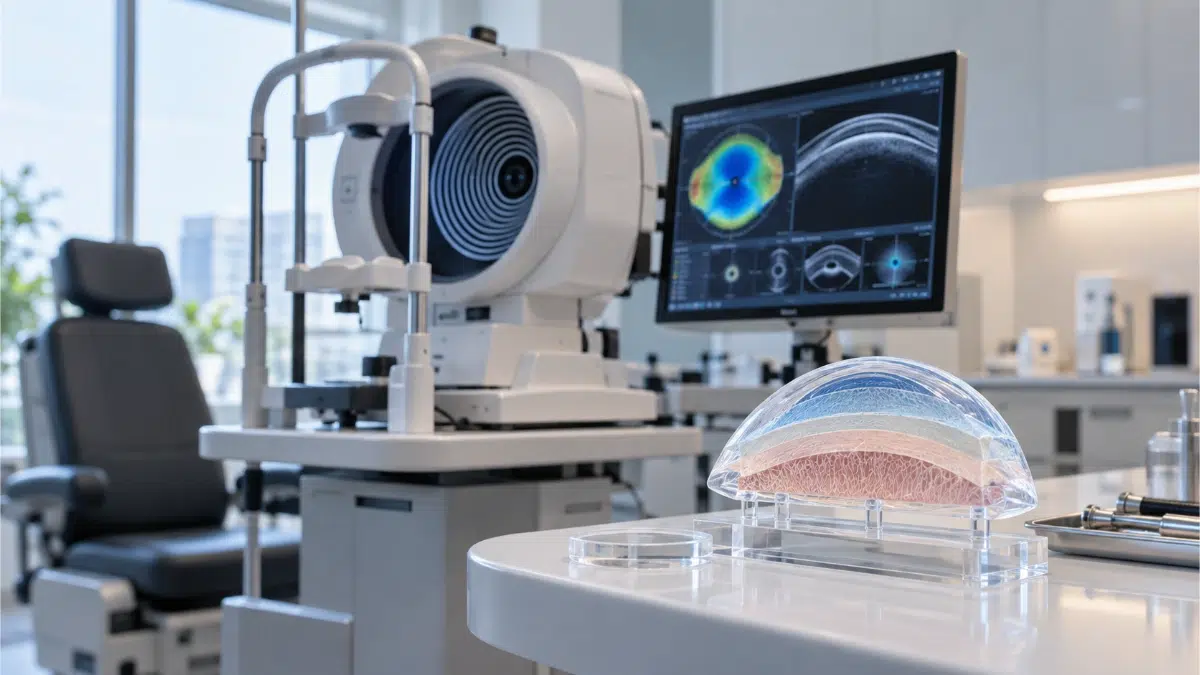
Having a thin cornea does not automatically mean that LASIK is impossible. It also does not mean that PRK or No-Touch Laser is automatically the safer choice.
Corneal thickness is only one part of refractive-surgery assessment. The ophthalmologist also needs to consider corneal shape, topography or tomography, refractive prescription, expected tissue removal and how much structurally important corneal tissue will remain afterwards.
This is why two patients with similar thickness measurements can receive different recommendations.
LASIK With Thin Corneas: Quick Answer
Having thin corneas does not automatically rule out LASIK, but thickness alone cannot determine suitability. Corneal shape, topography or tomography, prescription, expected tissue removal and remaining stromal tissue all matter. PRK or No-Touch Laser may be considered in selected patients, but neither is automatically suitable simply because the cornea is thin.
Can You Have LASIK With Thin Corneas?
Possibly.
Some patients with relatively thin but otherwise regular and stable corneas may still be suitable for laser vision correction.
LASIK requires sufficient tissue for both creation of the corneal flap and excimer-laser reshaping. PRK and other surface procedures avoid a LASIK flap but still remove corneal tissue.
Suitability therefore depends on the complete corneal assessment rather than one thickness number.
What Does “Thin Cornea” Mean?
Corneal thickness varies naturally between individuals.
The central cornea is commonly measured in micrometres, or µm. A relatively low measurement does not automatically indicate disease. Some people naturally have thinner corneas with otherwise regular shape and stable structure.
The more useful question is not simply:
“How many micrometres thick is my cornea?”
It is:
“Does my cornea have enough healthy and structurally stable tissue for the treatment being considered?”
How Is Corneal Thickness Measured?
Measurement of corneal thickness is called pachymetry.
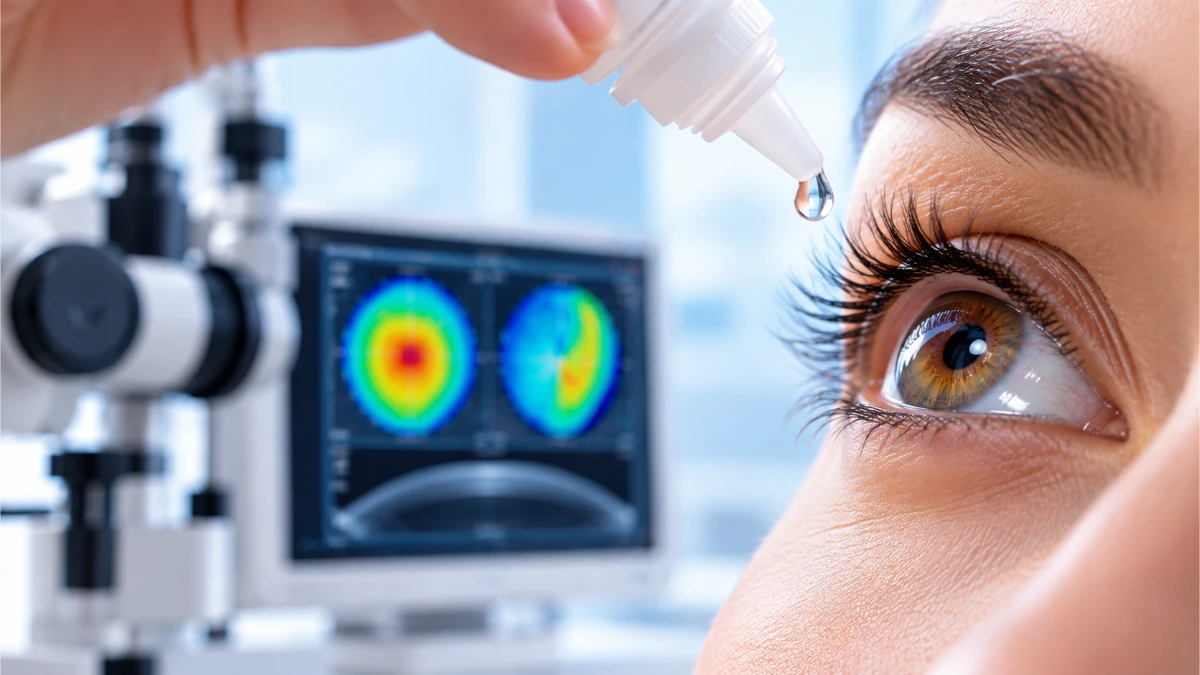
Depending on the equipment available, thickness may be measured using ultrasound or as part of corneal tomography and other imaging examinations.
Modern imaging may show:
- Central corneal thickness
- Thickness across different areas
- Location of the thinnest point
- How thickness changes across the cornea
Two corneas with similar central measurements can therefore have different structural patterns.
Our Corneal Topography Before Laser Eye Surgery guide explains why thickness should be interpreted together with corneal shape and tomography.
Is There a Minimum Corneal Thickness for LASIK?
There is no single corneal-thickness value that independently determines whether LASIK is appropriate for every patient.
Planning may consider:
- Original corneal thickness
- Planned flap thickness
- Expected laser-ablation depth
- Remaining stromal tissue
- Corneal shape and symmetry
- Topography or tomography
- Refractive prescription
A thickness value should therefore not be treated as a universal pass-or-fail threshold.
Why Does LASIK Require Enough Corneal Tissue?
LASIK changes the cornea in two main stages.
First, a thin corneal flap is created. The flap is then lifted, and an excimer laser reshapes the underlying corneal tissue.
The surgeon therefore needs to account for both the tissue involved in flap creation and the amount removed during laser ablation.
Enough structurally important tissue needs to remain after treatment. This is why the same starting thickness may be acceptable for one treatment plan but unsuitable for another.
What Is the Residual Stromal Bed?
The residual stromal bed, or RSB, is the stromal tissue expected to remain beneath the LASIK flap after laser ablation.
It is one factor considered during LASIK planning because excessive tissue removal may reduce corneal biomechanical stability.
Refractive-surgery literature has historically discussed approximately 250 µm as a minimum RSB value, while more conservative planning may use higher limits.
However, no single number guarantees safety.
RSB must be considered together with corneal shape, thickness distribution, prescription and other risk factors. Patients should not use an online threshold to decide their own eligibility. Pasted text
Why Does Your Prescription Matter?
The strength and type of refractive error affect how much corneal tissue needs to be reshaped.
A mild prescription may require less ablation than a stronger refractive correction. Planning may therefore consider the degree of myopia or hyperopia, astigmatism, treatment-zone size and expected ablation depth.
Two patients can have the same corneal thickness but very different treatment possibilities.
What Is Percent Tissue Altered?
Percent tissue altered, or PTA, estimates how much of the original central corneal thickness is affected by the combination of flap creation and laser ablation.
Higher PTA values have been associated with post-LASIK corneal ectasia in some patient groups.
For patients, the practical point is simple:
The question is not only how thick the cornea is before surgery, but how much tissue the planned procedure will alter.
PTA is one risk-assessment tool and cannot predict an individual outcome by itself. Pasted text
Does a Thin Cornea Mean Keratoconus?
No.
A naturally thin cornea can still have regular shape and no evidence of structural disease. Keratoconus, by contrast, is a condition in which the cornea progressively changes shape and may become thinner and steeper.
Assessment may consider the location of the thinnest point, anterior and posterior corneal shape, elevation, thickness distribution, symmetry and differences between the two eyes.
A relatively thick cornea is not automatically suitable either. Suspicious topography or tomography can still make laser treatment inappropriate.
Both the quantity of tissue and the quality of corneal structure matter. Pasted text
Why Does Keratoconus Matter Before LASIK?
LASIK removes and reshapes corneal tissue.
If the cornea already shows structural instability, further alteration may increase concern about corneal ectasia, in which the cornea progressively weakens and changes shape.
Someone considered unsuitable for LASIK because of suspected corneal instability should not simply be moved to another laser procedure without further assessment.
Is PRK Better for Thin Corneas?
PRK may be considered in some patients with relatively thinner corneas because it does not require creation of a LASIK flap.
Avoiding flap creation can preserve tissue compared with a flap-based approach in selected cases.
However:
“Thin cornea = PRK” is not a reliable rule.
PRK still removes corneal tissue. If topography or tomography suggests keratoconus, another ectatic disorder or structural instability, PRK may also be inappropriate.
Our LASIK vs PRK guide explains these differences in more detail. Pasted text
Is No-Touch Laser Better for Thin Corneas?
Not automatically.
No-Touch Laser generally refers to a flap-free surface-laser technique. Because a conventional LASIK flap is not created, it may be considered in selected cases where corneal thickness influences procedure choice.
The ophthalmologist still needs to evaluate corneal thickness, shape, topography or tomography, prescription, expected ablation depth, remaining tissue and signs of structural instability.
Avoiding a flap does not make an unsuitable cornea suitable for laser treatment.
Our No-Touch Laser vs Femto LASIK guide explains the procedural differences in more detail. Pasted text
Can Topography Be Normal but the Cornea Still Be Too Thin for LASIK?
Yes.
Normal corneal mapping is reassuring, but it does not automatically establish suitability.
A patient may have regular topography but a combination of corneal thickness and refractive correction that would require too much tissue alteration.
The reverse is also true: adequate thickness does not compensate for suspicious structural findings.
What Happens If My Cornea Is Too Thin for LASIK?
Being unsuitable for LASIK does not automatically mean that something is wrong with your eyes.
It may simply mean that the proposed treatment would not leave an appropriate structural margin for your particular cornea and prescription.
Depending on the findings, the ophthalmologist may:
- Consider a surface-laser procedure in selected patients
- Repeat or reassess measurements
- Request additional corneal imaging
- Investigate possible keratoconus
- Discuss another refractive option where appropriate
- Recommend glasses or contact lenses
- Advise against refractive surgery
The appropriate alternative depends on why LASIK is unsuitable.
Can Dry Eye Affect Thin-Cornea Assessment?
Dry eye does not usually make the cornea structurally thin in the same way measured by pachymetry.
However, an unstable tear film can reduce the quality and repeatability of some corneal measurements.
If measurements are inconsistent, the ocular surface may need to be treated before final planning.
Our Dry Eye Before LASIK guide explains why a stable ocular surface matters.
Does Age Affect the Decision?
Yes, although age does not replace corneal measurements.
For patients over 40, presbyopia, natural-lens changes, early cataract development and near-vision requirements may also influence whether corneal laser surgery is the most appropriate option.
Our LASIK After 40 guide explains these additional considerations.
What Should Patients Ask About a Thin Cornea?
Useful questions include:
- What is my corneal thickness?
- Where is the thinnest point?
- Are my topography and tomography findings normal?
- Is there any sign of keratoconus or ectasia risk?
- How much tissue would LASIK affect?
- What residual stromal tissue is expected?
- Why is a particular procedure being recommended?
- Is there any reason not to perform corneal laser surgery?
Patients do not need to calculate these measurements themselves, but they should understand how the findings influence treatment planning.
Thin Corneas and Laser Eye Surgery at Avicenna International Hospital
At Avicenna International Hospital’s Eye Center in Istanbul, currently listed refractive-laser options include:
- PRK-LASEK
- No-Touch Laser
- Femto LASIK (i-LASIK)
A relatively thin cornea should not automatically lead to one particular laser technique.
Treatment planning should consider corneal thickness together with corneal shape, topography or tomography, refractive prescription, expected tissue removal and evidence of structural stability.
For international patients, previous prescriptions and ophthalmic records may assist with preliminary review. Final eligibility and procedure selection require an ophthalmic examination and appropriate corneal measurements.
For a broader overview of refractive treatment, see our Laser Eye Surgery guide.
Frequently Asked Questions
Can You Have LASIK With Thin Corneas?
Possibly. Suitability depends on corneal thickness, structure, tomography, prescription and expected remaining tissue.
Is There a Minimum Corneal Thickness for LASIK?
There is no single thickness value that independently guarantees LASIK suitability or safety for every patient.
Is PRK Better for Thin Corneas?
It may be considered in selected patients because it avoids a LASIK flap, but thin corneas do not automatically make PRK appropriate.
Is No-Touch Laser Safer for Thin Corneas?
Not automatically. It is flap-free, but corneal structure, prescription and expected tissue removal still need to be assessed.
Does a Thin Cornea Mean Keratoconus?
No. A naturally thin cornea can be healthy. Keratoconus requires a broader assessment of corneal shape and structure.
What Is the Residual Stromal Bed?
It is the stromal tissue expected to remain beneath the LASIK flap after laser ablation and is one factor considered during planning.
Can a Thick Cornea Still Be Unsuitable for LASIK?
Yes. Suspicious topography, tomography or other evidence of instability can make laser surgery inappropriate despite adequate thickness.
What Happens If My Cornea Is Too Thin for LASIK?
Another procedure may be considered in selected patients, or corneal laser surgery may be avoided. The decision depends on why LASIK is unsuitable.