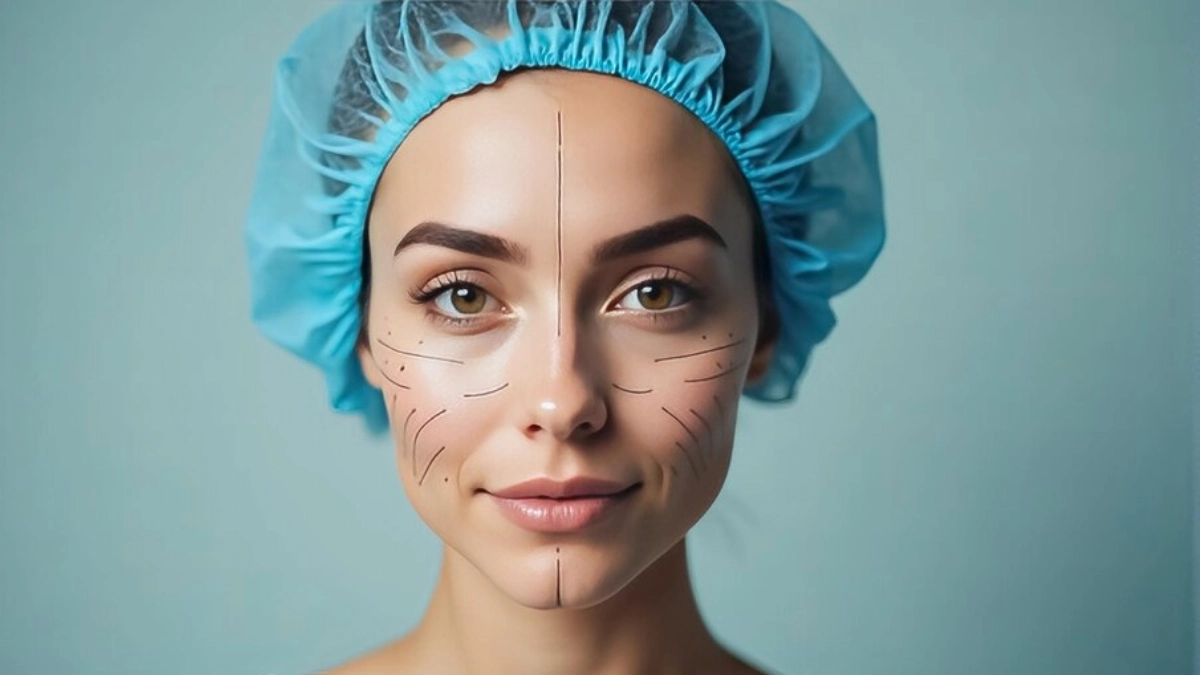
Facial fat transfer, also called facial fat grafting or lipofilling, uses fat taken from another part of the patient’s body to add or restore volume in selected areas of the face. The fat is collected with liposuction, prepared and then injected into areas where additional volume or contour correction is needed.
The procedure can be useful for facial volume loss, but it does not correct every sign of facial ageing. Significant loose skin or tissue descent may require a different treatment. Another consideration is that some of the transferred fat is reabsorbed, so the appearance immediately after the procedure does not represent the final result.
For patients considering facial fat transfer in Turkey, treatment planning should be based on facial anatomy, the location of volume loss, skin and tissue laxity, previous cosmetic procedures, available donor fat and the changes the patient wants to achieve.
What can facial fat transfer correct?
Facial fat transfer is primarily used to restore volume or improve facial contour.
Ageing can change the distribution and volume of facial fat as well as the position of deeper tissues. In selected patients, fat grafting may help restore volume in areas that have become hollow or less defined.
Treatment may involve areas such as:
- cheeks and midface
- temples
- areas around the mouth
- selected depressions or contour irregularities
- chin or jawline when additional volume is appropriate
Fat grafting may also be used in reconstructive surgery for certain facial contour defects.
The areas treated and the amount of fat used should be determined from the patient’s anatomy. A standard injection pattern is not appropriate for every face.
What can facial fat transfer not correct?
Fat transfer adds volume. It does not provide the same correction as surgery that removes substantial excess skin or repositions significantly descended facial tissues.
Facial ageing may involve several different changes, including:
- volume loss
- skin laxity
- tissue descent
- changes in skin quality
A patient with hollow cheeks may therefore have very different treatment needs from someone whose main concern is jowling or loose skin along the lower face.
Adding more volume is not always the correct response to facial ageing. The surgeon first needs to determine whether loss of volume is actually contributing to the feature the patient wants to change.
Where does the transferred fat come from?
The fat comes from the patient’s own body.
Possible donor areas include:
- abdomen
- thighs
- flanks
- other areas with sufficient suitable fat
There is no single donor site that is best for every patient. The choice depends on body anatomy, available fat and the planned procedure.
Because the fat must first be harvested, facial fat transfer involves two treatment areas: the donor site and the face. Recovery therefore includes both the facial injection areas and the area where liposuction was performed.
How is facial fat transfer performed?
The procedure generally involves three stages: harvesting, preparation and injection.
First, the surgeon removes fat from a suitable donor area using a liposuction technique. The harvested material is then processed before it is used for grafting.
Small amounts of prepared fat are injected into selected facial areas according to the planned contour correction.
Technique matters because transferred fat needs to establish a blood supply in the recipient tissue to survive. The surgeon must therefore consider facial anatomy, injection depth, treatment area and the amount of volume required.
A small localised hollow requires a different approach from volume restoration across several facial regions.
How much transferred fat survives?
Not all transferred fat survives permanently.
After grafting, some fat cells establish a blood supply and remain in the treated area, while another portion may be reabsorbed during healing. This is one reason the early postoperative appearance should not be used to judge the final result.
Published research has reported considerable variation in retained fat volume between studies. Differences in surgical technique, measurement methods, treatment areas and patient characteristics make it inappropriate to predict one exact survival percentage for an individual patient.
Patients should expect some reduction in volume as swelling resolves and part of the grafted fat is reabsorbed.
Are facial fat transfer results permanent?
The fat that successfully establishes itself can provide long-term volume, but this does not mean that all injected fat remains permanently.
The retained fat continues to behave as living tissue. Ageing and changes in body weight may therefore alter facial appearance over time.
For this reason, facial fat transfer should not be described as producing a fixed permanent result.
The result is assessed after early swelling has settled and the transferred volume has had time to stabilise.
Can you need more than one fat transfer?
Yes. Some patients may have another fat-transfer procedure if the amount of retained volume is lower than desired, further correction is appropriate or treatment is intentionally performed in stages.
This possibility should be discussed before the first procedure.
Because fat retention varies, a surgeon cannot reliably promise that a particular injected volume will result in an exact permanent increase in facial volume.
Facial fat transfer vs dermal fillers
Both facial fat transfer and dermal fillers can add volume, but they are different procedures.
Dermal fillers use injectable materials and do not require liposuction. They may be suitable when a patient wants a relatively targeted, non-surgical volume adjustment.
Fat transfer uses the patient’s own harvested fat. It requires a donor site and a surgical harvesting procedure and may be considered when broader volume restoration is appropriate.
Neither option is automatically better.
The choice may depend on:
- the area being treated
- the amount of volume required
- whether the patient prefers a surgical or non-surgical treatment
- availability of donor fat
- previous cosmetic treatments
- expected duration and predictability
- individual risks and preferences
The decision should be based on the anatomical problem being treated rather than the assumption that natural tissue is always preferable or that fillers necessarily produce an unnatural result.
Can facial fat transfer replace a facelift?
Not necessarily.
Fat transfer mainly restores or adds volume. A facelift addresses different anatomical changes, particularly tissue descent and laxity.
A patient may have volume loss, tissue descent or both.
If volume loss is the main concern, fat grafting may be considered without a facelift. If pronounced jowling or lower-face laxity is present, adding fat alone may not correct the underlying problem.
In selected patients, fat transfer can be combined with facial surgery when both volume and tissue position need to be addressed. Combining procedures should be based on the patient’s anatomy and clinical needs rather than convenience or package pricing.
What are microfat and nanofat?
Microfat and nanofat refer to different ways of preparing harvested fat. They should not be treated as interchangeable techniques.
Fat used for structural volume restoration needs viable adipose tissue that can survive after transfer. More finely processed fat preparations may be used for different purposes or tissue planes.
Nanofat is extensively processed and is not primarily intended to create the same type of structural volume augmentation as conventional fat grafting.
Claims that nanofat guarantees stem-cell rejuvenation, reverses ageing or regenerates skin should be treated cautiously. Research continues into adipose-derived cells and processed fat preparations, but these findings should not be translated into guaranteed cosmetic results for an individual patient.
Who may be suitable for facial fat transfer?
Facial fat transfer may be considered when a patient has volume loss or a contour concern that can reasonably be improved by adding autologous fat.
The surgeon may assess:
- location and degree of volume loss
- facial proportions
- skin and soft-tissue laxity
- previous fillers or facial surgery
- available donor fat
- general health
- medications and supplements
- smoking or nicotine use
- treatment expectations
The patient also needs enough suitable donor fat for the planned procedure.
Age alone does not determine suitability. Two people of the same age can have very different patterns of facial ageing and may require different treatments.
How is facial fat transfer planned?
Planning begins by identifying where additional volume would improve facial contour and where adding volume would not address the underlying problem.
The surgeon assesses the face as a whole rather than treating each hollow or line independently. This is particularly important when the main issue is tissue laxity or descent rather than volume loss.
Assessment may include:
- facial symmetry
- facial proportions
- existing volume distribution
- skin characteristics
- soft-tissue laxity
- previous fillers
- previous fat transfer
- previous facial surgery
The donor area also needs to be examined because harvesting the fat creates an additional treatment site.
Patients who have previously received fillers or undergone facial surgery should provide details about these treatments whenever possible.
What is recovery like after facial fat transfer?
Recovery involves both the face and the donor area.
Swelling and bruising can occur in the facial treatment areas. The donor site may also develop swelling, bruising or tenderness after liposuction.
Recovery varies according to:
- the amount of fat harvested
- the donor area
- the number of facial areas treated
- the amount of fat transferred
- whether other procedures were performed
- individual healing
Patients receive instructions about wound care, medication, activity and follow-up according to their procedure.
The face can initially look fuller than expected because of swelling. As swelling decreases and some transferred fat is reabsorbed, the contour changes further.
There is no single day or week when every patient’s final result can be judged.
What are the risks of facial fat transfer?
Facial fat grafting is a surgical procedure and has possible complications.
These may include:
- swelling and bruising
- infection
- asymmetry
- contour irregularity
- undercorrection or overcorrection
- fat necrosis
- oil cyst formation
- prolonged swelling
- irregularities at the donor site
- the need for further treatment
Published medical literature has also described rare but serious vascular complications when injected fat enters a blood vessel. Reported consequences include visual impairment, stroke and other neurological injury.
These complications are uncommon but potentially severe. Detailed knowledge of facial vascular anatomy and appropriate injection technique are therefore important.
Using the patient’s own fat does not make the procedure risk-free.
Individual risk depends on the treatment area, technique, previous procedures, medical history and other patient-specific factors.
Does facial fat transfer improve skin quality?
Research has examined possible changes in skin characteristics after fat grafting and the biological effects of adipose-derived cells.
Current evidence does not support promising predictable skin regeneration or “stem-cell rejuvenation” for every patient.
For an aesthetic facial fat-transfer procedure, the main expected effect should be described as a change in volume and contour. Any improvement in skin quality should be presented as a possible secondary effect rather than a guaranteed result.
How much does facial fat transfer cost in Turkey?
The cost of facial fat transfer in Turkey varies according to the extent of the procedure.
Factors that may affect the cost include:
- number of facial areas treated
- amount of fat required
- donor area and extent of liposuction
- anaesthesia requirements
- operating-room and hospital services
- whether another appropriate procedure is performed at the same time
- postoperative care
A single fixed price cannot accurately represent every facial fat-transfer procedure.
At Avicenna International Hospital, international patients may provide photographs and relevant medical information before travelling. This can help determine whether fat grafting appears suitable for the patient’s concern and which areas require assessment.
The final procedure and cost depend on the treatment recommended after appropriate evaluation.
What should international patients consider before facial fat transfer in Turkey?
International patients should plan for both surgery and early recovery before travelling.
Before treatment, patients should understand:
- which facial areas may be treated
- where donor fat may be harvested
- how long they may need to remain in Turkey
- when postoperative examinations are required
- when the surgeon considers travel appropriate
- how follow-up will continue after returning home
Useful information for the initial assessment may include:
- clear facial photographs from several angles
- the areas the patient wants to change
- relevant medical conditions
- current medications and supplements
- smoking or nicotine use
- previous dermal fillers
- previous fat grafting
- previous facial surgery
- allergies
- previous surgical complications
If fillers have previously been used, patients should provide the product name and treatment date when known.
Photographs are useful for preliminary assessment but cannot fully show tissue quality, mobility, depth of volume loss or donor-fat availability. The treatment recommendation may therefore change after an in-person examination.
How is facial fat transfer assessed at Avicenna?
At Avicenna International Hospital, assessment begins by determining whether the patient’s concern is mainly related to volume loss or whether skin laxity, tissue descent or another anatomical factor is more important.
The plastic surgeon may assess facial volume distribution, proportions, symmetry, skin and soft-tissue laxity, previous cosmetic treatments and available donor areas. Medical history, medication, smoking status and treatment expectations are also relevant.
If fat grafting is appropriate, planning includes both the facial treatment areas and the donor site.
Some patients may be suitable for fat transfer alone. Others may need another treatment, or fat grafting may be considered together with another procedure when there is a clinical reason to combine them.
For international patients, photographs and medical information can support an initial review before travel. Final suitability, treatment areas, transferred volume, technique and expected results depend on direct specialist assessment.
Frequently asked questions
Is facial fat transfer the same as facial fillers?
No. Fat transfer uses fat harvested from the patient’s own body. Dermal fillers use injectable products and do not require a donor site or liposuction.
Does all transferred fat stay in the face?
No. Some of the transferred fat is reabsorbed during healing. The amount that remains varies between patients and techniques.
How long does facial fat transfer last?
Fat that successfully survives transplantation can remain for the long term. The retained amount varies, and facial appearance continues to change with ageing and fluctuations in body weight.
Can facial fat transfer look unnatural?
Any volume-enhancing procedure can produce an undesirable contour if inappropriate areas or excessive volumes are treated. Planning should be based on facial anatomy rather than simply adding as much volume as possible.
Can facial fat transfer treat under-eye hollows?
It may be considered for selected lower-eyelid or upper-cheek volume concerns. This is an anatomically sensitive area, and suitability depends on the cause of the hollowing, tissue characteristics, previous treatments and specialist assessment.
Can facial fat transfer lift sagging skin?
Fat transfer can change facial volume and contour, but it does not provide the same correction as a surgical lift. Significant loose skin or tissue descent may require another treatment.
Can I have facial fat transfer if I am thin?
Possibly. The relevant question is whether enough suitable donor fat is available for the planned procedure.
Will I need a second facial fat transfer?
Not necessarily. Additional grafting may sometimes be considered when fat retention is lower than desired or further correction is appropriate.
How is the final treatment chosen?
The decision to perform facial fat transfer should begin with identifying the anatomical problem the patient wants to correct.
Volume loss, skin laxity and tissue descent can produce different facial changes and may require different treatments. Donor-fat availability, previous procedures, facial proportions and general health also affect planning.
Facial fat transfer can provide long-term volume in appropriately selected patients, but some transferred fat is expected to be reabsorbed and the retained amount cannot be predicted exactly for an individual patient.
The treatment areas, amount of fat transferred, recovery, risks and possibility of additional treatment should be discussed with the plastic surgeon before the procedure.