

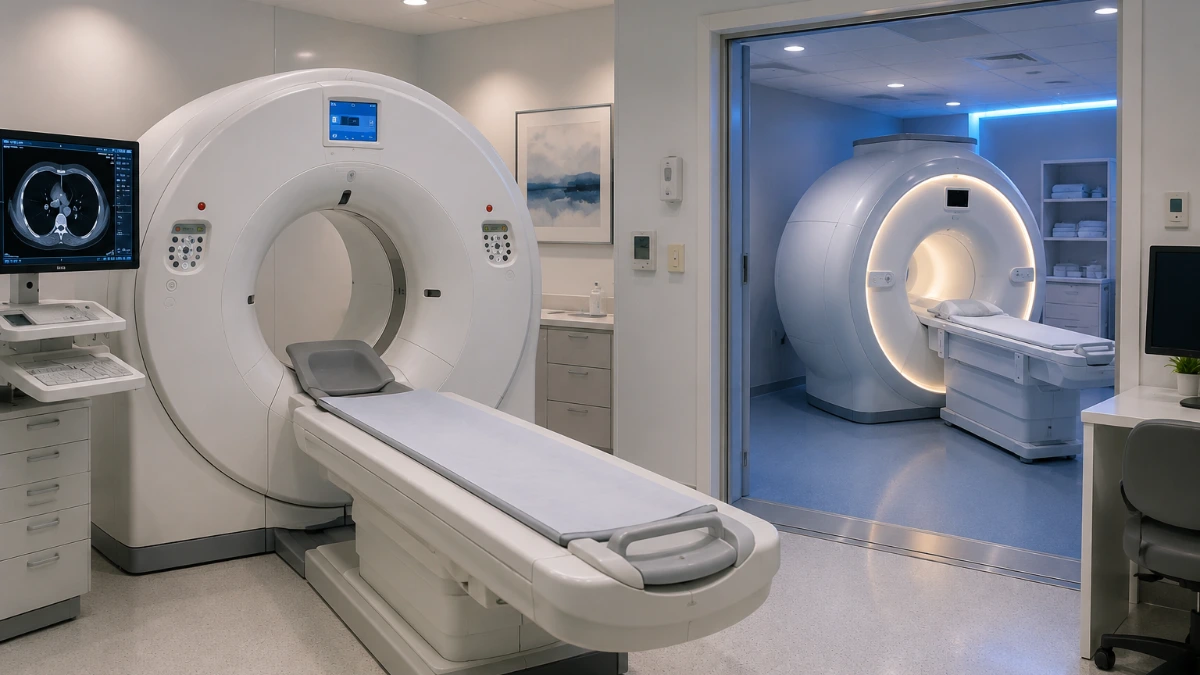
MRI and CT scans both produce detailed images of structures inside the body, but they work in different ways and are used for different clinical questions. If you are wondering about MRI vs CT scan, it’s important to know that CT uses X-rays, while MRI uses a strong magnetic field and radiofrequency signals and does not use ionising radiation.
Neither test is always better. Doctors choose between MRI and CT according to the part of the body being examined, the suspected condition, how quickly imaging is needed, and whether factors such as metal implants, pregnancy or contrast agents need to be considered.
What Is the Main Difference Between MRI and CT?
The main difference is the technology used to create the images.
CT uses X-rays taken from multiple angles to produce cross-sectional images of the body. MRI uses magnetic fields and radiofrequency signals to generate images without ionising radiation.
CT is often used when imaging needs to be completed quickly and can be useful for assessing the lungs, bones, acute bleeding and many emergency conditions.
MRI provides greater contrast between many types of soft tissue and is commonly used to examine the brain, spinal cord, joints, muscles, ligaments and other soft-tissue structures.
The appropriate test depends on what the doctor needs to investigate rather than which scanner is considered more advanced.
How Does a CT Scan Work?
During a CT scan, an X-ray source rotates around the body and collects measurements from different angles. A computer processes this information to create cross-sectional images of internal structures.
CT examinations are usually relatively quick, which is one reason they are commonly used in emergency assessment. They can help doctors identify injuries, bleeding and other conditions that require rapid imaging.
Some CT scans use a contrast agent to make blood vessels, organs or particular abnormalities easier to see. Whether contrast is needed depends on the clinical question and the patient’s health.
How Does an MRI Scan Work?
MRI uses a strong magnetic field and radiofrequency signals to create detailed images of internal tissues. It does not use ionising radiation.
MRI can provide detailed information about soft tissues and may be used to examine areas such as the brain, spine, joints, muscles, ligaments, organs and blood vessels.
MRI examinations generally take longer than CT scans. Patients also need to remain still while the images are being acquired, as movement can reduce image quality.
Because MRI uses a strong magnetic field, patients should tell the medical team about pacemakers, implanted devices, metal fragments or other implants before the examination.
Is MRI Better Than CT?
No. MRI is not universally better than CT, and CT is not universally better than MRI.
CT may be preferred when speed is important or when evaluating certain lung, bone, trauma or acute bleeding findings. MRI may be preferred when more detailed assessment of soft tissue is needed.
In some cases, both examinations may be used because they provide different types of information.
The choice depends on the suspected diagnosis, the part of the body being examined, the urgency of the situation, previous test results and individual factors such as implants or contrast-agent considerations.
MRI vs CT Scan: Which Is Better for Different Conditions?
MRI and CT can both provide detailed images of the body, but the more appropriate scan depends on what doctors need to investigate. CT is generally faster and is particularly useful for many emergency, lung and bone assessments. MRI provides greater soft-tissue contrast and is often preferred for the brain, spinal cord, joints and other soft-tissue structures.
Neither test is better in every situation. The choice depends on the suspected condition, body area, urgency, previous findings, patient safety and whether contrast is needed.
Which Is Better for the Brain: MRI or CT?
Both MRI and CT are used to examine the brain.
CT is often selected when rapid imaging is required, particularly in emergency assessment. MRI may be preferred when doctors need more detailed evaluation of brain tissue or when the clinical question is better answered by MRI.
Sometimes CT is performed first and MRI is requested later to investigate a finding in greater detail. The choice depends on the patient’s symptoms, urgency and suspected diagnosis.
Which Is Better for Bones and Joints?
CT provides detailed images of bone and can be useful for assessing complex fractures and bone structure.
MRI is particularly useful for joints and surrounding soft tissues because it can show structures such as:
- cartilage
- ligaments
- tendons
- muscles
- bone marrow
For joint problems, the appropriate scan depends on whether the main concern involves bone, soft tissue or both.
Which Is Better for Cancer: MRI or CT?
Neither MRI nor CT is the best examination for every cancer.
The choice depends on the cancer type, body area and whether imaging is being used for diagnosis, staging, treatment planning or follow-up.
CT can image several areas of the body relatively quickly and is commonly used during cancer assessment. MRI may provide additional detail when a tumour or surrounding soft tissue needs closer evaluation.
Some patients need both CT and MRI because the examinations provide different information.
Does MRI or CT Use Radiation?
CT uses ionising radiation. MRI does not.
The amount of radiation from CT depends on the body area, examination protocol and equipment. Doctors consider whether the expected diagnostic information justifies the radiation exposure before requesting the scan.
The absence of ionising radiation does not automatically make MRI the more appropriate examination. CT may provide the information needed more quickly or more effectively for a particular clinical question.
External source: Link the radiation information to an authoritative radiology source such as RadiologyInfo (ACR/RSNA).
Do MRI and CT Scans Require Contrast?
Not always. Both MRI and CT can be performed with or without contrast.
CT commonly uses iodine-based contrast agents when enhancement is needed. MRI generally uses gadolinium-based contrast agents.
Before receiving contrast, patients should tell the medical team about:
- previous contrast reactions
- kidney problems
- pregnancy or possible pregnancy
- relevant medical conditions
Whether contrast is required depends on the body area, suspected condition and purpose of the examination.
External source: An authoritative radiology source on contrast materials can be linked from this section.
Can You Have an MRI With a Metal Implant?
Many patients with implants can undergo MRI, but the specific implant or device must be checked before the scan.
Because MRI uses a strong magnetic field, some implanted devices or metallic objects may create safety concerns or interfere with image quality.
Patients should tell the imaging team about:
- pacemakers
- neurostimulators
- cochlear implants
- surgical clips
- implanted pumps or devices
- metal fragments
Having an implant does not automatically prevent MRI. The imaging team needs to identify the device and confirm the conditions under which MRI can be performed safely.
External source: Link the MRI safety information to an authoritative MRI safety resource.
Which Scan Is Faster?
CT is generally faster than MRI, which makes it useful when rapid assessment is required.
MRI examinations often take longer because several imaging sequences may be needed. Many examinations take approximately 15 to 45 minutes, although the duration can be shorter or longer depending on the body area and protocol.
CT image acquisition can be very rapid. The total appointment may take longer when preparation or contrast administration is required.
Can You Need Both MRI and CT?
Yes. Doctors may request both when the examinations provide complementary information.
CT might be used first to identify an abnormality or answer an urgent clinical question. MRI may then be requested to examine particular tissues or findings in greater detail.
A second scan does not necessarily mean that the first examination was inadequate. MRI and CT provide different types of information.
At Avicenna International Hospital, imaging decisions are based on the patient’s symptoms, medical history, previous findings and the clinical question being investigated. Existing scans may also be reviewed before further imaging is recommended.
MRI vs CT Scan: Quick Comparison
| MRI | CT | |
|---|---|---|
| Technology | Magnetic field and radiofrequency signals | X-rays |
| Ionising radiation | No | Yes |
| Soft-tissue assessment | Particularly useful | Useful depending on the body area |
| Bone assessment | Can assess bone and bone marrow | Particularly useful for detailed bone structure |
| Scan speed | Generally longer | Generally faster |
| Emergency imaging | Used when clinically appropriate | Often useful because imaging is rapid |
| Contrast | May use gadolinium-based contrast | May use iodine-based contrast |
| Metal implants and devices | Requires MRI safety screening | No strong magnetic field, although other safety considerations still apply |
This comparison is a general guide. The appropriate examination depends on the clinical question and the individual patient.
Frequently Asked Questions
Is MRI Safer Than CT?
MRI does not use ionising radiation, but that does not make it automatically safer or more appropriate for every patient. MRI has specific safety considerations involving some implants, devices and metallic objects, while CT involves radiation exposure.
Is MRI More Accurate Than CT?
Neither is universally more accurate. Accuracy depends on the body area, suspected condition and information the doctor needs.
Why Would a Doctor Order CT Instead of MRI?
CT may be preferred when imaging needs to be completed quickly or when detailed assessment of certain bone, lung or acute findings is required.
Why Would a Doctor Order MRI After CT?
MRI may provide additional information about a finding identified on CT or allow soft tissues to be examined in greater detail.
Can MRI Detect Things That CT Cannot?
MRI can provide greater contrast between certain soft tissues and may make some abnormalities easier to assess. CT may provide more useful information for other conditions.
Can CT Detect Things That MRI Cannot?
CT can be particularly useful for certain bone abnormalities, lung findings, calcification and acute conditions. It also acquires images quickly.
Do I Need Contrast for MRI or CT?
Not necessarily. Some examinations use contrast and others do not. The decision depends on the body area, suspected condition and information required.
Can I Choose MRI Instead of CT to Avoid Radiation?
Not always. MRI and CT are not interchangeable for every condition. The doctor or radiologist selects the examination expected to answer the clinical question.
Which Scan Is Better for Claustrophobia?
CT examinations are generally shorter, and the scanner is less enclosed than a conventional MRI scanner. MRI may be more difficult for some patients with claustrophobia. Patients should discuss this with the imaging team before the examination.
Can Pregnant Patients Have MRI or CT?
Imaging during pregnancy is selected according to medical need. Patients who are pregnant or may be pregnant should tell their doctor and imaging team before the examination. MRI does not use ionising radiation, while CT does. Contrast use also requires individual assessment.
How Do Doctors Choose Between MRI and CT?
Doctors choose MRI or CT according to the clinical question the examination needs to answer. The suspected condition, body area, urgency, previous findings, patient safety and need for contrast can all affect the decision.
At Avicenna International Hospital, diagnostic imaging is selected according to the patient’s clinical assessment. Existing scans may be sufficient in some cases, while other patients may need CT, MRI or another examination before the diagnosis or treatment plan can be confirmed.