Where a breast implant is placed affects how much tissue covers the implant, how it interacts with the chest muscle, early recovery and some implant-related risks. When considering breast augmentation, you may wonder about breast implants over vs under the muscle, as implant placement is therefore an important part of breast augmentation planning.
Patients often hear about implants being placed over or under the muscle, but these are not the only options. Dual-plane and subfascial techniques may also be considered in selected patients.
There is no single implant position that is best for everyone. Existing breast tissue, skin quality, chest anatomy, implant dimensions, previous surgery and the desired result all influence the decision.
What Does Breast Implant Placement Mean?
Breast implant placement refers to the anatomical pocket created to hold the implant in relation to the breast tissue and the pectoralis major muscle.
The main approaches include:
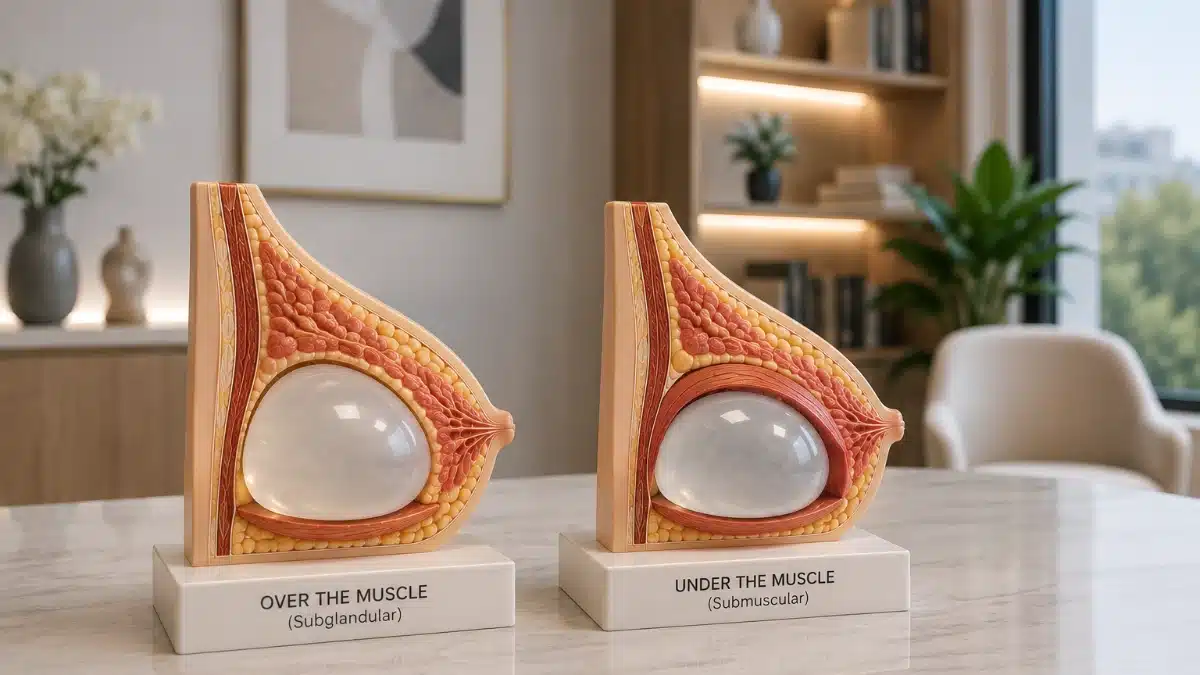
- Subglandular: behind the breast tissue and above the pectoral muscle
- Submuscular: beneath the pectoral muscle
- Dual plane: partly beneath the muscle, with adjustment of the relationship between the muscle and breast tissue
- Subfascial: beneath the fascia covering the pectoral muscle but above the muscle itself
Placement is only one part of breast augmentation planning. Implant size, shape, width, projection and the patient’s natural breast anatomy also influence the final appearance.
What Are Over-the-Muscle Breast Implants?
Over-the-muscle breast augmentation usually refers to subglandular placement. The implant sits behind the breast tissue but in front of the pectoralis major muscle.
Because the chest muscle is not elevated to accommodate the implant, there is less direct involvement of the muscle during surgery. This may mean less muscle-related tightness during early recovery and avoids the muscle-driven implant movement known as animation deformity.
The trade-off is that there is less tissue covering the implant than with submuscular placement. In patients with thin skin or limited natural breast tissue, implant edges or rippling may therefore be more noticeable.
Over-the-muscle placement may be considered when there is sufficient natural tissue to cover the implant. However, tissue thickness is not the only consideration. Breast shape, skin quality, implant dimensions and the desired result also influence whether this placement is appropriate.
What Are Under-the-Muscle Breast Implants?
With submuscular placement, the implant is positioned beneath the pectoralis major muscle, providing additional tissue coverage over part of the implant.
This may be useful when a patient has limited natural breast tissue and additional coverage is desirable, particularly in the upper breast.
There are also disadvantages to consider. Because the chest muscle is involved, patients may experience more muscle-related tightness or discomfort during early recovery. Contraction of the pectoralis muscle can also cause visible movement or distortion of the implant in some patients. This is known as animation deformity.
Under-the-muscle placement is therefore not automatically better or more natural. Its advantages and limitations need to be considered in relation to the patient’s anatomy and implant characteristics.
What Is Dual-Plane Breast Augmentation?
Dual-plane breast augmentation combines characteristics of submuscular placement with adjustment of the relationship between the muscle and breast tissue.
The upper part of the implant is covered by the pectoralis muscle, while the surgeon modifies the relationship between the muscle and breast tissue lower down. This can provide additional coverage over the upper implant while allowing greater control over the lower breast.
There are different variations of the dual-plane technique. It is not appropriate for every breast shape and should be selected according to anatomy and the intended surgical correction rather than simply because it is considered a newer technique.
What Is Subfascial Breast Implant Placement?
With subfascial placement, the implant is positioned beneath the fascia covering the pectoralis major muscle while remaining above the muscle itself.
It provides another possible implant pocket between conventional subglandular and submuscular approaches.
As with other placement options, whether subfascial augmentation is appropriate depends on tissue characteristics, implant dimensions and the surgical plan.
Over vs Under the Muscle: Key Differences
| Factor | Over the Muscle | Under the Muscle |
|---|---|---|
| Position | Behind breast tissue, above muscle | Beneath pectoral muscle |
| Muscle involvement | Minimal | Greater |
| Implant coverage | Mainly breast tissue and skin | Additional muscle coverage |
| Early muscle discomfort | Usually less | May be greater |
| Animation deformity | Not caused by pectoral coverage | Can occur |
| Visible edges or rippling | May be more relevant with thin tissue | Additional coverage may help |
| Typical consideration | Adequate natural tissue coverage | Additional implant coverage is useful |
These are general differences rather than fixed rules. Tissue thickness, implant characteristics and surgical technique can significantly affect the result.
Which Implant Placement Looks More Natural?
Neither over-the-muscle nor under-the-muscle placement automatically produces a more natural-looking breast.
The result depends on how the implant relates to the patient’s existing breast tissue, chest dimensions and skin. A patient with limited natural tissue may benefit from additional implant coverage, while someone with sufficient tissue may be suitable for an over-the-muscle approach.
Implant dimensions are equally important. An implant that is poorly matched to the breast width and available tissue may look less natural regardless of where it is positioned.
Implant size and placement should therefore be planned together rather than treated as separate decisions.
Patients considering different implant dimensions can also read Avicenna’s guide to How to Choose the Best Breast Implant Size in Turkey.
Does Implant Placement Affect Rippling?
Yes, implant placement can influence how visible or palpable rippling is, although it is not the only factor.
Rippling occurs when folds or irregularities in the implant can be seen or felt through the surrounding tissue. Limited soft-tissue coverage can make this more noticeable.
This may be particularly relevant when considering over-the-muscle placement in a patient with thin breast tissue. Additional tissue coverage with other placement techniques may help in selected patients.
The risk also depends on implant characteristics and the patient’s anatomy, so placement should not be considered in isolation.
Does Implant Placement Affect Capsular Contracture?
Capsular contracture occurs when the scar capsule that naturally forms around a breast implant becomes unusually tight. It can cause firmness, discomfort or changes in breast shape.
Implant pocket may influence the risk, but it is only one factor. Surgical technique, implant characteristics and patient-specific factors can also contribute.
Choosing an implant position solely because of one potential complication does not account for the other anatomical and surgical considerations involved in breast augmentation.
What Is Animation Deformity?
Animation deformity is visible movement or distortion of a breast implant when the pectoralis muscle contracts.
It can occur when implants are positioned in relation to the chest muscle and may become particularly noticeable during movements that strongly activate the pectoralis, including certain upper-body exercises.
This can be an important consideration for physically active patients.
Placing an implant above the muscle avoids muscle-driven animation, but it introduces other considerations, particularly the amount of natural tissue available to cover the implant.
Is Recovery Different Over vs Under the Muscle?
Recovery varies between patients, but involvement of the pectoralis muscle can affect the early postoperative period.
With under-the-muscle placement, patients may experience more chest tightness or muscle-related discomfort initially. Over-the-muscle placement does not require elevation of the pectoralis in the same way.
Swelling, soreness and temporary restrictions on physical activity can occur with either approach.
Patients may also be advised to wear a supportive garment and restrict strenuous activity while the tissues heal. Return to work, exercise and normal activities should follow the surgeon’s instructions and individual recovery rather than a fixed online timeline.
How Does a Surgeon Choose Breast Implant Placement?
Choosing an implant pocket requires several factors to be considered together:
- Amount of existing breast tissue
- Soft-tissue thickness
- Breast width and shape
- Skin quality
- Degree of breast sagging
- Chest-wall anatomy
- Implant dimensions and volume
- Previous breast surgery
- Physical activity
- Desired breast shape
- Individual risk factors
The patient’s preferred appearance is important, but anatomy determines which options are appropriate.
This is also why implant placement should not be selected from before-and-after photographs alone. Two patients who look similar externally may have different breast dimensions, tissue thickness or chest anatomy.
Can Breast Implants Correct Sagging?
Breast implants primarily add volume. They do not necessarily correct significant breast sagging, medically known as ptosis.
If the breast or nipple has descended substantially, changing implant size or placement may not provide the required correction. A breast lift may need to be considered separately or together with breast augmentation.
Patients deciding between these procedures can also read Breast Augmentation vs Breast Lift: Which One Is Right for You?
Breast Implant Placement for International Patients
Patients travelling for breast augmentation in Turkey should understand where the proposed implant will be positioned and why that placement has been recommended.
Useful questions to discuss before surgery include:
- Where will the implant be positioned?
- Why is this placement suitable for my anatomy?
- Which implant dimensions and volume are being considered?
- What alternative placements are possible?
- Where will the incision be?
- What risks are relevant to my procedure?
- What should I expect during recovery?
- When can I return to exercise?
- How will follow-up continue after I return home?
Photographs and medical information can support preliminary planning, but they cannot establish every anatomical factor involved in choosing an implant pocket.
Final implant selection and placement require clinical assessment.
Breast Implant Surgery at Avicenna International Hospital
At Avicenna International Hospital in Istanbul, breast augmentation planning considers the patient’s existing breast tissue, skin and chest anatomy, medical history, previous procedures and treatment goals.
Implant dimensions and placement are assessed together because the same implant can behave differently depending on the available tissue coverage and the pocket in which it is positioned.
For international patients, preliminary assessment may begin before travelling by providing relevant medical information and photographs. The final implant choice, placement and surgical plan are determined following clinical evaluation.
Frequently Asked Questions
Is It Better to Have Breast Implants Over or Under the Muscle?
Neither placement is best for everyone. The choice depends on existing breast tissue, skin quality, chest anatomy, implant characteristics and treatment goals.
Which Implant Placement Looks More Natural?
Natural appearance depends on the relationship between the implant and the patient’s anatomy rather than placement alone. Tissue coverage, implant width, projection and volume all contribute to the result.
Is Under-the-Muscle Breast Augmentation More Painful?
Submuscular placement can involve more muscle-related tightness or discomfort during early recovery because the pectoralis muscle is involved. Individual experiences vary.
What Is Dual-Plane Breast Augmentation?
Dual-plane augmentation provides muscle coverage over the upper part of the implant while modifying the relationship between the muscle and breast tissue lower down. It may be useful for selected anatomical situations.
Can Breast Implants Move When I Exercise?
Implants positioned in relation to the pectoralis muscle can move or distort when the muscle contracts in some patients. This is called animation deformity.
Does Implant Placement Affect Implant Size?
The decisions are related. Breast width, available tissue, implant dimensions and the selected pocket should be considered together rather than choosing implant size independently.
Can Implant Placement Be Changed Later?
Changing the implant pocket may be possible during revision surgery in selected patients. Suitability depends on the reason for revision, existing tissues, scar capsule and previous surgical technique.