
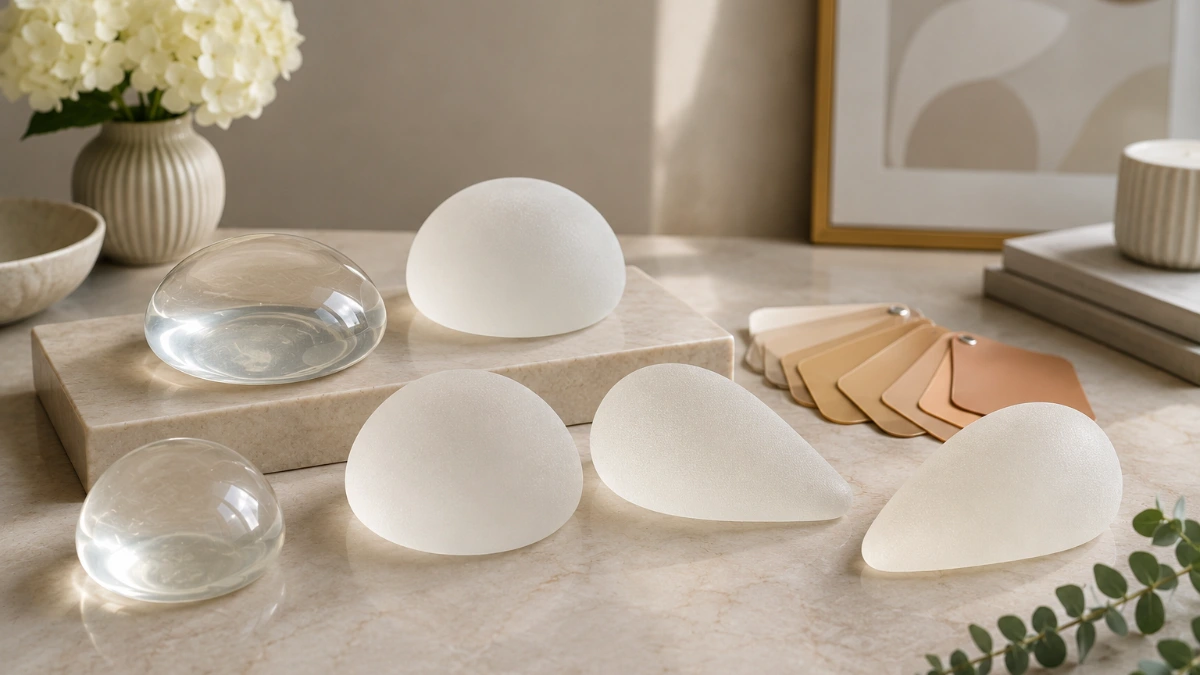
Choosing a breast implant involves more than deciding on volume. Understanding different breast implant types is important because implants differ in filling material, shape, surface, width, projection, and gel consistency. These characteristics affect how an implant behaves and how it fits the patient’s existing breast and chest anatomy.
The most familiar comparison is silicone vs. saline breast implants, but implant shape, profile, surface, and placement also need to be considered.
There is no single breast implant type that is best for everyone. Breast dimensions, existing tissue, skin quality, chest anatomy, planned implant placement, and the desired result all influence implant selection.
What Are the Main Types of Breast Implants?
Breast implants can be classified according to several characteristics:
- Filling: silicone gel or saline
- Shape: round or anatomical
- Surface: smooth or textured
- Profile: different degrees of forward projection
- Gel consistency: silicone implants are available with different degrees of cohesiveness.
These characteristics are combined in different ways. Two implants can contain the same volume but have different widths, profiles, or shapes and therefore produce different results.
This is why choosing an implant according to volume in cc alone does not provide enough information about how it will fit a particular patient.
What Are Silicone Breast Implants?
Silicone breast implants have a silicone outer shell filled with silicone gel. They are available in different sizes, widths, profiles, shapes, and levels of gel cohesiveness.
Silicone gel generally has a consistency closer to breast tissue than saline. However, filling material alone does not determine how natural an augmented breast feels. The amount of existing breast tissue, implant dimensions, and placement also affect the result.
Another difference involves rupture. A silicone implant does not necessarily collapse if the shell ruptures. The gel may remain within the implant shell or surrounding implant pocket, so rupture can sometimes occur without an obvious visible change.
What Are Cohesive or Gummy Bear Breast Implants?
The term “gummy bear implant” is commonly used for form-stable silicone implants containing a more cohesive silicone gel.
The gel is thicker than that used in some other silicone implants and is designed to maintain its form more effectively.
“Gummy bear” is an informal description rather than a completely separate category of breast implant.
Greater cohesiveness can affect how an implant maintains its shape and behaves within the breast, but more cohesive does not automatically mean better or more natural. The appropriate gel consistency depends on the implant design, available tissue, and intended breast shape.
What Are Saline Breast Implants?
Saline breast implants also have a silicone outer shell, but the shell is filled with sterile saline solution rather than silicone gel.
One of the main differences becomes apparent if the implant ruptures. When a saline implant leaks, it generally deflates and the saline is absorbed by the body. This usually makes rupture more noticeable than a silent rupture of a silicone implant.
Depending on the implant design, saline implants may be filled during surgery.
In patients with limited natural breast tissue, folds or rippling may be more noticeable with saline implants. However, this also depends on implant size, placement, and the amount of tissue covering the implant.
Silicone vs. Saline Breast Implants: What Is the Difference?
The main difference is the material inside the implant and what happens if the implant shell develops a leak.
| Factor | Silicone Implants | Saline Implants |
|---|---|---|
| Filling | Silicone gel | Sterile saline solution |
| Outer shell | Silicone | Silicone |
| Feel | Gel generally behaves more like breast tissue. | May feel firmer depending on tissue coverage |
| If rupture occurs | May remain unnoticed | Implants usually deflate. |
| Rupture monitoring | Imaging may be needed to identify silent rupture. | Deflation is often clinically noticeable. |
| Rippling | Depends on implant and tissue coverage | May be more noticeable with thin tissue |
| Designs | Multiple shapes, profiles, and gel consistencies | Multiple sizes and profiles |
Neither filling material should be selected from this comparison alone. The surgeon also needs to consider how the implant’s dimensions relate to the patient’s breast, chest, and available tissue.
What Happens If a Silicone Implant Ruptures?
A silicone implant rupture can sometimes be silent, meaning that there may be no obvious symptoms or visible change in the breast.
When symptoms do occur, possible changes can include a change in breast shape or size, lumps, uneven appearance, pain, tenderness, swelling, or altered sensation.
Imaging may therefore be used to assess silicone implant integrity.
Long-term monitoring is an important consideration for patients choosing silicone implants. The appropriate imaging schedule depends on current recommendations, the specific implant, symptoms, and the patient’s clinical circumstances.
A suspected rupture should be assessed medically rather than relying on appearance alone.
Round vs. Anatomical Breast Implants
Implant shape is another part of breast augmentation planning.
Round Breast Implants
Round implants are symmetrical and have the same general contour regardless of rotation within the implant pocket.
They are available in different widths and profiles. Depending on the implant dimensions and the patient’s anatomy, a round implant can provide different degrees of upper-breast fullness and forward projection.
A round implant does not automatically produce an artificial or excessively full appearance. When its width, projection, volume, and placement suit the patient’s tissues, it can produce a relatively subtle result.
Anatomical Breast Implants
Anatomical implants have more volume toward the lower portion and a tapered upper contour. They are also commonly called teardrop-shaped implants.
Because an anatomical implant has a defined upper and lower orientation, rotation within the implant pocket can alter the appearance of the breast. This differs from a round implant, where rotation generally does not produce the same shape problem.
An anatomical implant may be considered for particular anatomical or reconstructive objectives, but it should not automatically be considered more natural than a round implant.
Which Looks More Natural: Round or Anatomical Implants?
Neither shape automatically produces a more natural-looking breast.
The result depends on how well the implant fits the patient’s existing anatomy. Relevant factors include:
- Existing breast tissue
- Breast width
- Chest-wall shape
- Skin quality
- Implant volume
- Implant width and projection
- Implant placement
- Position of the natural breast and nipple
A carefully selected round implant can look natural, while an anatomical implant that does not fit the patient’s breast dimensions may produce a less suitable result.
Shape should therefore be considered together with implant dimensions and placement.
What Is Breast Implant Profile?
Implant profile describes how far the implant projects forward in relation to its base width.
Terms such as “low,” “moderate,” and “high” profile are commonly used, although exact classifications differ between manufacturers.
Two implants with the same volume can have very different dimensions. One may have a wider base with less forward projection, while another may be narrower and project further from the chest.
For example, choosing a 300 cc implant does not by itself determine how wide the implant will be or how much projection it will create.
Implant volume should therefore be considered together with breast width, implant width and projection.
Patients comparing implant dimensions can also read Avicenna’s guide to How to Choose the Best Breast Implant Size in Turkey.
Does Breast Implant Surface Matter?
Breast implants may have smooth or textured surfaces.
Smooth implants can move more freely within the implant pocket. Textured surfaces were developed to encourage greater interaction between the implant surface and surrounding tissue and have been used for particular surgical applications.
Implant surface is also an important safety consideration.
Breast implant-associated anaplastic large cell lymphoma, or BIA-ALCL, is a lymphoma associated with the capsule and fluid surrounding certain breast implants. It is not breast cancer. The risk is higher with textured implants than with smooth-surface implants.
Patients should therefore know which implant surface is being proposed and discuss with their surgeon why that particular device has been selected and what risks are associated with it.
Does Implant Type Affect Placement?
Yes. Implant type and implant placement should be planned together.
The amount of natural breast tissue, implant dimensions, chest anatomy, and desired breast shape can influence whether an implant is positioned above or below the pectoral muscle or using another pocket technique. width,
A patient with limited tissue coverage, for example, may require a different approach from someone with thicker natural breast tissue.
Patients comparing implant pockets can also read Breast Implants Over vs. Under the Muscle: Which Is Better?
How Does a Surgeon Choose the Right Breast Implant?
There is no reliable formula based only on height, weight, desired cup size, or implant volume.
A breast augmentation assessment may consider:
- Breast base width
- Existing breast volume
- Soft-tissue thickness
- Skin elasticity
- Chest-wall dimensions
- Breast asymmetry
- Degree of sagging
- Nipple position
- Implant placement
- Previous breast surgery
- Lifestyle and physical activity
- Desired degree of fullness and projection
The implant should fit the available tissue rather than requiring the patient’s tissues to accommodate a predetermined implant.
This is also why choosing an implant based only on photographs of another patient can be misleading. Patients who appear similar externally may have different breast widths, chest-wall anatomy, skin characteristics, and tissue coverage.
Do Breast Implants Last a Lifetime?
Breast implants should not be considered lifetime devices.
This does not mean that every implant needs to be replaced automatically after a particular number of years. There is no universal rule requiring breast implants to be replaced at exactly 10 years.
However, the possibility of complications and further surgery increases over time. Some patients eventually require implant removal, replacement, or revision because of rupture, capsular contracture, changes in appearance, or other problems.
Long-term follow-up is therefore part of having breast implants, regardless of which implant type is selected.
Choosing Breast Implants as an International Patient
Patients travelling for breast augmentation in Turkey should understand more than the implant brand and volume before surgery.
Useful questions to discuss with the surgical team include:
- Is the implant silicone or saline?
- Is it round or anatomical?
- What are its width and profile?
- Is the surface smooth or textured?
- Why is this implant suitable for my anatomy?
- Where will the implant be placed?
- What risks are associated with this implant?
- How should the implant be monitored over time?
- What happens if rupture or another complication is suspected?
- How will follow-up continue after I return home?
Patients should also receive information about the specific implant being used and understand the proposed surgical plan before proceeding.
Photographs can help communicate the appearance a patient prefers, but they cannot determine which implant dimensions will fit that patient’s tissues.
Breast Implant Surgery at Avicenna International Hospital
At Avicenna International Hospital in Istanbul, breast implant selection is considered together with the patient’s breast and chest anatomy, existing tissue, skin characteristics, medical history, and treatment goals.
Implant volume alone does not determine the result. Shape, width, projection, filling material, and placement all affect how the implant relates to the patient’s existing breast.
For international patients, a preliminary assessment may begin before travelling by providing relevant medical information and photographs. Final implant selection, placement, and the surgical plan are determined following clinical evaluation.
Frequently Asked Questions
Are Silicone or Saline Breast Implants Better?
Neither is best for every patient. The appropriate choice depends on anatomy, implant availability, surgical planning, and patient preference.
Do Silicone Implants Feel More Natural?
Silicone gel generally behaves more like natural breast tissue than saline, but the final feel also depends on tissue coverage, implant dimensions, and placement.
Are Round Implants Less Natural Than Teardrop Implants?
Not necessarily. Round implants can produce a natural appearance when their width, profile, volume, and placement suit the patient’s anatomy.
What Are Gummy Bear Breast Implants?
“Gummy bear” is an informal term for form-stable silicone implants containing a more cohesive silicone gel.
What Happens If a Saline Implant Ruptures?
A saline implant usually deflates if its shell leaks. The saline is absorbed by the body, but the ruptured implant still requires medical assessment and usually surgical management.
Do Breast Implants Need to Be Replaced Every 10 Years?
Not automatically. Breast implants are not lifetime devices, but there is no universal requirement to replace an implant at exactly 10 years.
Which Breast Implant Is Best for Me?
The choice depends on breast dimensions, available tissue, skin quality, chest anatomy, implant placement, and the desired result. The implant that suits one patient may not be appropriate for another.