
Having dry eyes does not automatically rule out laser eye surgery, but it can affect whether treatment is appropriate and how it should be planned. It’s important to understand how dry eye before LASIK may impact your candidacy and recovery.
Before LASIK, PRK or another corneal laser procedure, the ophthalmologist needs to assess the tear film and ocular surface as well as the prescription and corneal structure. Existing dry-eye disease can affect comfort, visual quality and the reliability of preoperative measurements, while LASIK itself can temporarily worsen dryness in some patients.
Some patients can proceed after the ocular surface has been treated and stabilised. In others, significant or persistent dry-eye disease may lead to surgery being postponed, a different refractive approach being considered or corneal laser surgery being avoided.
Dry Eye Before LASIK: Quick Answer
Having dry eye does not automatically mean that you cannot have LASIK. The cause and severity of the ocular-surface problem need to be assessed first, and clinically significant dry eye may need treatment before surgery. LASIK can temporarily worsen dryness, while PRK or No-Touch Laser is not automatically a better option. Procedure selection depends on tear-film health, corneal measurements and the complete eye examination.
Can You Have LASIK If You Have Dry Eyes?
Possibly.
Dry-eye symptoms alone do not automatically make LASIK unsuitable. What matters is the cause and severity of the problem, whether the ocular surface is stable and whether it responds adequately to treatment.
A patient with mild, manageable dry eye may be reassessed after treatment.
Someone with significant uncontrolled ocular-surface disease may need surgery postponed.
In some cases, the ophthalmologist may determine that corneal laser surgery is not appropriate.
What Is Dry Eye Disease?
Dry eye is more complicated than simply producing too few tears.
It is a multifactorial condition involving disruption of the tear film and ocular surface. Tear-film instability, increased evaporation, reduced tear production, inflammation, surface damage, meibomian gland dysfunction and neurosensory abnormalities can all contribute.
Two patients with similar symptoms can therefore have very different underlying problems.
This matters before refractive surgery because treatment should address the cause of the ocular-surface instability rather than the sensation of dryness alone.
Why Does the Tear Film Matter Before LASIK?
The tear film forms the first optical surface that light passes through when entering the eye.
When it is unstable, patients may experience:
- Burning or stinging
- Gritty or foreign-body sensation
- Intermittent blurred vision
- Fluctuating vision
- Light sensitivity
- Redness
- Eye fatigue
- Excessive watering despite feeling dry
A stable tear film is also important for reliable refractive and corneal measurements.
For this reason, dry-eye assessment is part of surgical planning rather than simply a way of managing postoperative discomfort.
Does LASIK Cause Dry Eyes?
LASIK can cause or worsen dry-eye symptoms.
During LASIK, a corneal flap is created and the underlying corneal tissue is reshaped. This affects corneal nerves involved in sensation, blinking and tear-related reflexes.
Temporary changes in corneal sensation and tear-film stability can therefore occur after treatment.
For many patients, postoperative dryness improves during healing. However, symptoms vary considerably, and some patients can experience more persistent problems.
Pre-existing dryness should therefore be evaluated rather than ignored because the patient’s prescription or corneal thickness otherwise appears suitable.
Why Can Dry Eye Cause Fluctuating Vision?
A healthy tear film creates a relatively smooth optical surface.
When that layer breaks up irregularly, the way light passes through the front of the eye can change from moment to moment.
Patients may notice:
- Clearer vision immediately after blinking
- Blur developing several seconds later
- Difficulty maintaining focus while using screens
- Variable sharpness while reading
- Increased glare or visual disturbance in dry environments
Before laser eye surgery, the goal is not simply to obtain one accurate prescription. Measurements should represent a reasonably stable ocular surface.
Can Dry Eye Affect LASIK Measurements?
Yes.
An unstable tear film can affect measurements involving corneal curvature and the eye’s optical system.
This becomes particularly important when treatment planning relies on precise corneal measurements.
If the ocular surface is significantly unstable, the ophthalmologist may first treat the dry eye and then repeat the measurements.
Unreliable measurements should not be used simply because they were obtained during the first examination.
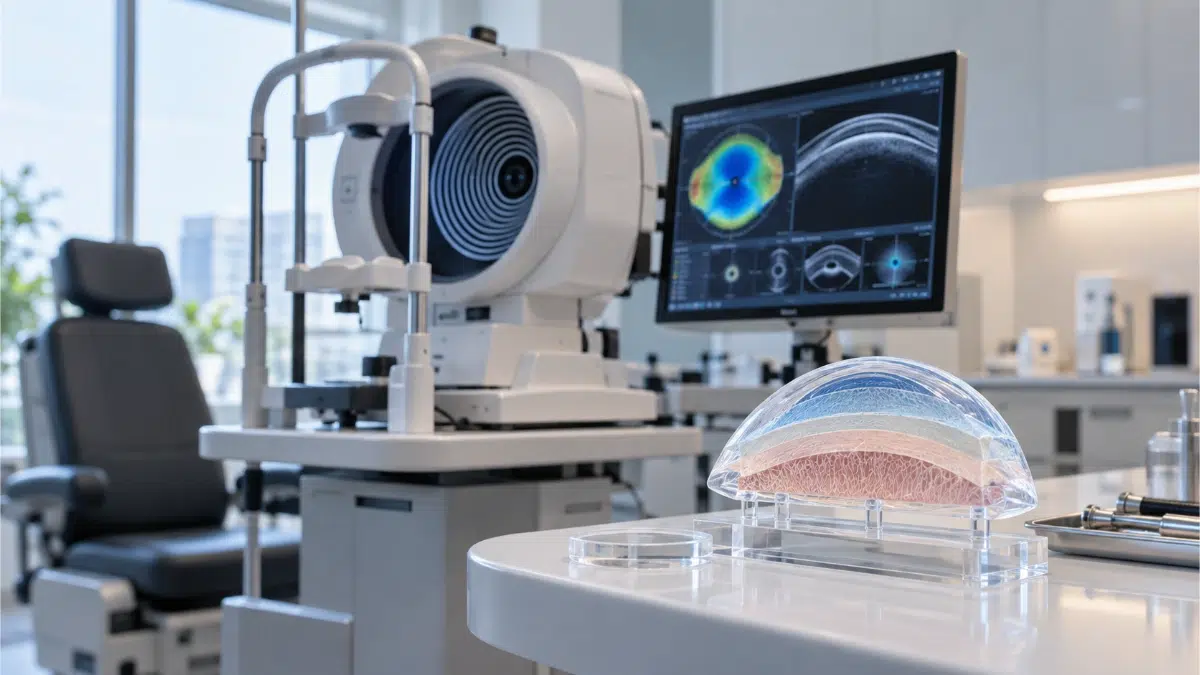
Our Corneal Topography Before Laser Eye Surgery guide explains why corneal measurements need to be interpreted together with ocular-surface quality and other clinical findings.
How Is Dry Eye Evaluated Before Laser Eye Surgery?
There is no single test that fully describes dry-eye disease.
Assessment may combine the patient’s symptoms with examination of the tear film, eyelids, meibomian glands, cornea and conjunctiva.
Depending on the patient and clinic, evaluation may include:
- Symptom assessment
- Tear-film break-up time
- Ocular-surface staining
- Tear-production testing
- Tear osmolarity
- Eyelid examination
- Meibomian-gland assessment
- Blink evaluation
- Examination of the corneal and conjunctival surfaces
The objective is not merely to classify the patient as having or not having dry eye.
The more useful question is what is causing the ocular-surface instability and whether it needs treatment before refractive surgery.
What Is Tear Break-Up Time?
Tear break-up time measures how long the tear film remains stable after blinking.
A short break-up time can indicate tear-film instability.
Testing may be performed with fluorescein dye or with non-invasive imaging, depending on the equipment available.
The result should not be interpreted alone. Symptoms, surface staining, eyelid findings and other measurements also contribute to the assessment.
What Is the Schirmer Test?
The Schirmer test provides information about tear production.
A small paper strip is placed at the lower eyelid, and the amount of moisture reaching the strip is measured.
The test can be useful when reduced aqueous tear production is suspected, but it does not identify every form of dry eye.
A patient may have relatively normal tear production but still experience significant dryness because tears evaporate too quickly or because of meibomian gland dysfunction.
Schirmer testing is therefore one part of the examination rather than a complete diagnosis by itself.
What Is Ocular-Surface Staining?
Special dyes can be used during an eye examination to make areas of ocular-surface stress or damage easier to identify.
Fluorescein can help assess the cornea and tear film, while other staining agents may provide additional information about the ocular surface.
These tests can reveal changes that are not obvious from symptoms alone.
This is useful because symptom severity and visible clinical signs do not always correspond closely.
What Is Tear Osmolarity?
Tear osmolarity measures the concentration of dissolved substances in the tear film.
Abnormal osmolarity can be associated with disturbance of normal tear-film stability.
Like other dry-eye tests, it should be interpreted within the complete clinical picture rather than used alone to determine whether someone can undergo LASIK.
What Are the Meibomian Glands?
Meibomian glands are located within the eyelids.
They produce oils that form part of the tear film and help slow tear evaporation.
When these glands do not function normally, a condition called meibomian gland dysfunction, or MGD, can develop.
A patient can therefore produce a reasonable amount of watery tears and still experience dry-eye symptoms because the tear film evaporates too quickly.
Assessment before refractive surgery may consequently need to include the eyelid margins, gland openings and blink pattern as well as the cornea itself.
Can Contact Lenses Affect Dry Eye Before LASIK Assessment?
Yes.
Contact lenses can affect both the ocular surface and corneal measurements.
Some patients develop:
- Irritation
- Tear-film instability
- Redness
- Contact-lens intolerance
- Dry-eye symptoms
Contact lenses can also temporarily alter corneal shape.
Patients may therefore be asked to stop wearing them before final refractive measurements.
The required interval depends on the type of lens and the ophthalmologist’s instructions.
Does Dry Eye Need to Be Treated Before LASIK?
Clinically significant dry eye or other ocular-surface disease may need treatment before refractive surgery is planned.
Treatment depends on the underlying cause rather than following one programme for every patient.
Depending on the findings, management can include:
- Tear supplementation
- Eyelid care
- Treatment of meibomian gland dysfunction
- Anti-inflammatory therapy where appropriate
- Environmental changes
- Behavioural changes
- Other targeted ocular-surface treatments
The objective is to improve ocular-surface health and obtain stable, reliable measurements before surgery is reconsidered.
How Long Does Dry Eye Need to Be Treated Before LASIK?
There is no single waiting period.
Timing depends on factors such as:
- Severity of symptoms
- Cause of the dry eye
- Tear-film stability
- Ocular-surface staining
- Meibomian-gland health
- Eyelid function
- Response to treatment
- Reliability of repeated measurements
The important issue is not whether a certain number of weeks has passed.
The ophthalmologist needs to determine whether the ocular surface has become sufficiently stable for accurate measurements and reasonable surgical planning.
Can LASIK Be Postponed Because of Dry Eye?
Yes.
Postponement does not necessarily mean that the patient will never be able to have laser eye surgery.
It may simply mean that the ocular surface needs to be treated first and reassessed.
Preoperative examination is intended to determine whether surgery is appropriate, not to make every patient suitable for treatment on the day of assessment.
Sometimes delaying surgery is the safer clinical decision.
Is PRK Better Than LASIK for Dry Eyes?
Not automatically.
PRK avoids creation of a LASIK flap, so the pattern of corneal nerve disruption is different.
However, PRK still alters the cornea and can also cause postoperative dryness, irritation and fluctuating vision.
Some patients with dry-eye concerns may eventually be considered for a surface procedure, but this cannot be decided from symptoms alone.
The underlying ocular-surface problem should first be evaluated and treated where necessary.
The rule:
“I have dry eyes, so PRK must be better for me”
is too simplistic.
Our LASIK vs PRK guide explains the wider differences between flap-based and surface laser procedures.
Is No-Touch Laser Better for Dry Eyes?
Not automatically.
No-Touch Laser generally refers to a flap-free surface procedure, often using a transepithelial technique.
Avoiding a conventional LASIK flap can be relevant when comparing procedures, but surface treatment still requires epithelial healing and can produce postoperative dryness and irritation.
Dry eye should therefore not be used as a stand-alone reason to choose No-Touch Laser.
The decision requires assessment of both ocular-surface health and the other factors affecting refractive-surgery suitability.
Our No-Touch Laser vs Femto LASIK guide explains the procedural differences in more detail.
Can Severe Dry Eye Make Laser Eye Surgery Unsuitable?
Yes.
Significant uncontrolled dry-eye disease may require surgery to be postponed or can make corneal refractive surgery inappropriate in some patients.
The ophthalmologist also needs to consider whether symptoms are being caused by:
- Eyelid disease
- Meibomian gland dysfunction
- Inflammation
- Ocular-surface damage
- Abnormal corneal sensation
- Another eye disorder
A patient should not be considered suitable simply because the cornea is thick enough or the refractive prescription lies within a treatable range.
Why Do Corneal Nerves Matter?
Corneal nerves contribute to more than sensation.
They are involved in reflex pathways associated with:
- Tear production
- Blinking
- Ocular-surface maintenance
- Corneal healing
LASIK affects corneal nerves during flap creation and stromal reshaping.
This can temporarily reduce corneal sensitivity and alter normal tear-related reflexes.
Corneal nerves regenerate over time, but the rate and extent of recovery vary.
This helps explain why dry-eye symptoms can be particularly noticeable during the early period after LASIK.
What Dry-Eye Symptoms Can Occur After LASIK?
Possible postoperative symptoms include:
- Dryness
- Burning
- Stinging
- Grittiness
- Foreign-body sensation
- Intermittent blurred vision
- Fluctuating vision
- Light sensitivity
- Eye fatigue
- Excessive tearing
Some of these symptoms can overlap with other postoperative problems.
New, severe, worsening or persistent symptoms require ophthalmic assessment rather than simply increasing lubricating drops without further evaluation.
Can Dry Eye Affect Night Vision After LASIK?
It can contribute.
An unstable tear film can reduce optical quality and may make glare or fluctuating clarity more noticeable.
However, night-vision symptoms after refractive surgery are not caused only by dry eye.
Other contributing factors can include:
- Residual refractive error
- Pupil characteristics
- Corneal optics
- Healing changes
- Other ocular conditions
Patients who depend heavily on night driving should mention this during the preoperative assessment.
Can Dry Eye Continue Long After LASIK?
For many patients, postoperative dryness improves as healing progresses.
Persistent symptoms can occur in some people.
When dryness continues, the cause may involve more than simple tear deficiency.
Possible contributors include:
- Meibomian gland dysfunction
- Ocular-surface inflammation
- Surface damage
- Eyelid abnormalities
- Abnormal nerve-related pain
Persistent or substantial symptoms therefore deserve reassessment.
Is Eye Pain After LASIK Always Caused by Dry Eye?
No.
Ocular discomfort and dry-eye symptoms can overlap, but persistent pain is not always explained by tear-film findings.
In some patients, nerve-related or neuropathic pain may need to be considered.
Severe or persistent pain should therefore be assessed by an ophthalmologist rather than assumed to represent ordinary postoperative dryness.
What Does Current Dry-Eye Research Suggest?
Current evidence supports identifying and stabilising ocular-surface disease before refractive surgery rather than waiting for symptoms to worsen after treatment.
Modern dry-eye frameworks recognise the condition as multifactorial and recommend interpreting symptoms together with objective signs of tear-film or ocular-surface abnormality rather than relying on a single test.
Research focused on refractive surgery also supports careful preoperative screening because ocular-surface health can affect postoperative symptoms, measurement reliability and visual quality.
Differences in postoperative dry-eye findings have been reported between LASIK and surface procedures, but these findings do not establish one procedure as universally preferable for every patient with dry eye.
The practical conclusion is not that one procedure is always better. It is that the ocular surface should be evaluated and, when necessary, stabilised before the refractive procedure is selected.
How Does Dry Eye Affect the Choice of Laser Procedure?
Dry-eye status is one part of a broader refractive-surgery assessment.
The ophthalmologist may also consider:
- Refractive error
- Prescription stability
- Corneal thickness
- Corneal topography or tomography
- Tear-film stability
- Ocular-surface condition
- Meibomian gland health
- Eyelid function
- Age
- Lifestyle
- Occupation
- Risk of eye trauma
- Visual requirements
After the ocular surface is treated, some patients may still be suitable for more than one technique.
For others, the available options may become more limited.
In some cases, the appropriate recommendation may be not to perform corneal laser surgery.
Dry Eye, Corneal Topography and Reliable Measurements
Dry-eye assessment and corneal imaging are closely related during refractive-surgery planning.
An unstable tear film can make some corneal measurements less reliable.
At the same time, topography and tomography provide information about whether the cornea itself appears structurally suitable for laser reshaping.
This is why procedure selection cannot be reduced to prescription alone.
A patient with a prescription of -3.00, for example, may still have very different treatment considerations depending on corneal structure, tear-film health and the rest of the ophthalmic examination.
Our Corneal Topography Before Laser Eye Surgery guide explains how corneal shape and structural measurements contribute to the same decision.
Planning LASIK With Dry Eyes as an International Patient
Patients travelling for laser eye surgery should be particularly careful about arranging a fixed procedure date when significant dry-eye symptoms are present.
An online consultation may assist with preliminary planning but cannot replace examination of the tear film and ocular surface.
Before travelling, useful questions include:
- Will my tear film and ocular surface be assessed?
- Should I stop wearing contact lenses before examination?
- What happens if my ocular surface is unstable?
- Could surgery be postponed?
- Will my measurements be repeated after dry-eye treatment?
- Which laser procedure is being considered and why?
- How much postoperative follow-up will I need?
- What should I do if dryness worsens after I return home?
Travel arrangements should allow for the possibility that final treatment depends on the examination performed after arrival.
Dry Eye and Laser Eye Surgery at Avicenna International Hospital
Avicenna International Hospital’s Eye Center in Istanbul currently lists the following refractive-laser options:
- PRK-LASEK
- No-Touch Laser
- Femto LASIK (i-LASIK)
Patients with dry-eye symptoms considering refractive treatment should have the ocular surface considered as part of the overall ophthalmic assessment.
Avicenna’s public Eye Center information does not currently describe one standard dry-eye screening protocol that is applied to every refractive-surgery patient, nor does it state that one laser technique is automatically preferred whenever dry eye is present.
The appropriate tear-film and ocular-surface examinations should therefore be determined according to the individual patient’s clinical assessment.
For a broader overview of refractive treatment, patients can also read our Laser Eye Surgery guide. More specific comparisons are available in LASIK vs PRK, No-Touch Laser vs Femto LASIK, and Corneal Topography Before Laser Eye Surgery.
Frequently Asked Questions
Can I Have LASIK If I Have Dry Eyes?
Possibly. Mild or treatable dry eye does not automatically rule out LASIK, but the ocular surface may need to be stabilised first.
Does LASIK Make Dry Eye Worse?
It can temporarily worsen dryness and may aggravate existing symptoms in some patients.
Does Everyone Get Dry Eye After LASIK?
No. Dry-eye symptoms vary considerably in severity and duration between patients.
Is PRK Better for Dry Eyes?
Not automatically. PRK avoids a LASIK flap but can still cause postoperative dryness and ocular-surface symptoms.
Is No-Touch Laser Better for Dry Eyes?
Not automatically. It is generally a flap-free surface approach, but dry-eye disease still requires individual assessment.
Should Dry Eye Be Treated Before LASIK?
Clinically significant dry eye may need treatment before surgery so that the ocular surface and preoperative measurements become more stable.
What Tests Are Used for Dry Eye Before LASIK?
Assessment may include tear-film break-up time, ocular-surface staining, Schirmer testing, eyelid and meibomian-gland examination and other tear-film tests when appropriate.
Can Dry Eye Affect LASIK Measurements?
Yes. Tear-film instability can make some refractive and corneal measurements less reliable.
Can Contact Lenses Affect Dry Eye Before LASIK?
Yes. They can contribute to irritation in some patients and can also temporarily change corneal shape.
Can Severe Dry Eye Prevent LASIK?
Yes. Significant uncontrolled ocular-surface disease may lead to postponement or make corneal refractive surgery unsuitable.
How Long Does Dry Eye Last After LASIK?
There is no fixed duration. Symptoms often improve with healing, but persistent problems can occur in some patients.
Which Laser Eye Procedure Is Best If I Have Dry Eyes?
There is no universally best option. The decision depends on the cause and severity of dry eye together with corneal anatomy, refractive error and the rest of the ophthalmic examination.