
No-Touch Laser and Femto LASIK are both used for laser vision correction, but they reach and treat the cornea in different ways.
Femto LASIK creates a thin corneal flap using a femtosecond laser before an excimer laser reshapes the underlying tissue. No-Touch Laser generally refers to a flap-free surface-laser approach, often using a transepithelial technique.
This difference affects early visual recovery, postoperative discomfort, surface healing and whether flap-related risks need to be considered.
Neither procedure is automatically better. The appropriate technique depends on the patient’s refractive error, corneal thickness and shape, ocular-surface health, lifestyle, visual requirements and findings from a detailed eye examination.
No-Touch Laser vs Femto LASIK: Quick Answer
Femto LASIK creates a corneal flap before laser reshaping, while No-Touch Laser generally uses a flap-free surface approach. Femto LASIK usually provides faster early visual recovery and less initial discomfort, whereas surface treatment requires the corneal epithelium to heal. Neither is better for every patient; the choice depends on corneal anatomy, refractive error, ocular-surface health and a detailed eye examination.
No-Touch Laser vs Femto LASIK: Key Differences
| Feature | No-Touch Laser / Surface Treatment | Femto LASIK |
|---|---|---|
| Conventional corneal flap | No | Yes |
| Corneal surface | Epithelium is treated or removed | A flap is created and lifted |
| Excimer-laser reshaping | Yes | Yes |
| Early visual recovery | Generally slower | Generally faster |
| Early discomfort | Usually more noticeable | Usually less |
| Bandage contact lens | Commonly used | Usually not required for surface healing |
| Flap-related complications | No LASIK flap | Possible |
| Surface healing | Epithelium must regenerate | Less epithelial regeneration required |
| Final procedure choice | Based on individual examination | Based on individual examination |
The important distinction is not simply “touch” versus “no touch.” It is mainly the difference between surface ablation and flap-based laser treatment.
What Is No-Touch Laser?
“No-Touch Laser” is commonly used to describe a transepithelial surface-laser procedure.
In surface-ablation treatment, the corneal epithelium—the thin outer layer of the cornea—is treated or removed so that the underlying corneal tissue can be reshaped with an excimer laser.
With a transepithelial approach, laser energy can be used as part of both epithelial removal and refractive correction.
A conventional LASIK flap is not created.
After treatment, the epithelial surface needs to regenerate. A temporary bandage contact lens is commonly placed over the eye during this early healing stage.
Does “No-Touch” Always Mean the Same Procedure?
No.
“No-Touch Laser” is a treatment name rather than enough information to identify every technical detail of the procedure.
Different clinics and laser platforms may use the term differently, and protocols can vary.
Avicenna International Hospital’s public Eye Center information currently lists No-Touch Laser as an excimer-laser treatment option, alongside PRK-LASEK and Femto LASIK, but the page does not identify a specific No-Touch laser platform or detailed protocol.
Patients should therefore ask which exact procedure is being proposed, whether it is a transepithelial PRK-type treatment, which platform is being used, how the epithelial layer will be managed and why the approach is appropriate for their eyes.
These questions provide more useful information than the treatment name alone.
What Is Femto LASIK?
Femto LASIK is a form of LASIK in which a femtosecond laser creates the corneal flap.
The flap is lifted, and an excimer laser then reshapes the underlying corneal tissue according to the planned refractive correction. After laser reshaping, the flap is repositioned.
Femto LASIK therefore uses a femtosecond laser to create the flap and an excimer laser to reshape the underlying cornea.
For appropriately selected patients, one practical advantage is relatively fast early visual recovery.
Because a flap is created, however, flap-related considerations remain relevant during patient selection and postoperative care.
Does “No-Touch” Mean Nothing Touches the Eye?
Not necessarily.
The name can easily be misunderstood.
“No-Touch” generally refers to the surface-laser technique and the absence of mechanical creation of a conventional LASIK flap. In some systems, it also means that the epithelial layer does not need to be manually removed.
It should not be interpreted as meaning that absolutely nothing will contact the eye during examination, treatment or recovery.
Eye drops, diagnostic instruments and a postoperative bandage contact lens may still be used.
Patients should therefore understand the actual technique rather than relying on the commercial name.
Is No-Touch Laser the Same as PRK?
They belong to the same broader family of surface-ablation procedures, but the terms are not necessarily interchangeable.
In conventional PRK, the epithelial surface is removed before the excimer laser reshapes the cornea.
In transepithelial PRK, laser treatment can also be used during removal of the epithelial layer.
The underlying principle is similar: there is no conventional LASIK flap, and the corneal surface needs to heal after treatment.
The exact technique should be confirmed before treatment.
For a broader comparison of flap-based and surface treatment, see our LASIK vs PRK guide.
Which Procedure Has Faster Recovery?
Femto LASIK generally provides faster early visual recovery.
Because the corneal epithelium does not have to regenerate in the same way as it does after a surface procedure, useful vision often develops more quickly after LASIK.
After No-Touch or another transepithelial surface treatment, the epithelial layer needs time to heal. During this stage, vision may fluctuate, light sensitivity can occur, discomfort may be more noticeable and a bandage contact lens may be used.
Slower early recovery does not mean that the eventual visual result will necessarily be worse.
Which Procedure Is More Comfortable?
Femto LASIK generally causes less early postoperative discomfort.
No-Touch and other surface procedures can produce more noticeable symptoms while the epithelial layer regenerates. These may include burning, stinging, watering, foreign-body sensation, light sensitivity and blurred or fluctuating vision.
Anaesthetic eye drops are used during both procedures, so the main difference in comfort usually appears during the early postoperative period.
Individual experiences vary.
Does Femto LASIK Give Better Vision Than No-Touch Laser?
Not necessarily.
The procedures should not be compared simply by asking which one produces sharper vision.
Both Femto LASIK and transepithelial surface procedures can provide effective refractive correction in appropriately selected patients.
A prospective study of 114 eyes with low-to-moderate myopia found differences in early visual performance between Femto LASIK and TransPRK, while several visual-quality measures were no longer significantly different at three months.
A separate study involving 218 patients treated for low-to-moderate myopic astigmatism found similar three-month uncorrected and corrected distance visual acuity and comparable astigmatic treatment effects between TransPRK and Femto LASIK.
The practical differences therefore involve more than the eventual refractive result. Recovery, corneal anatomy, complication profile and patient selection also matter.
Is No-Touch Laser Better for Thin Corneas?
It may be considered in some patients with relatively thinner corneas because a conventional LASIK flap is not created.
However, a thin cornea does not automatically mean that No-Touch Laser is appropriate.
Assessment also needs to consider total corneal thickness, corneal shape, topography or tomography, the degree of refractive correction required, expected remaining corneal tissue and any signs of keratoconus or other corneal instability.
A structurally unsuitable cornea should not simply be treated with another laser technique.
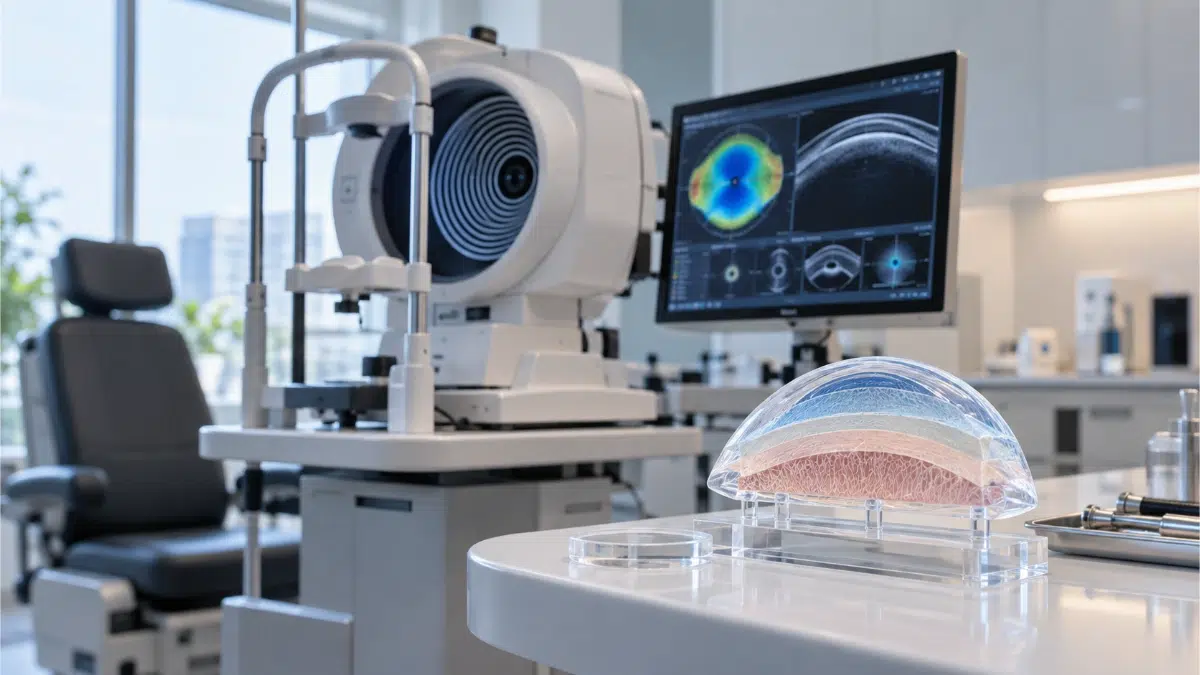
Why Does Corneal Mapping Matter?
Corneal thickness alone does not describe the complete structure of the cornea.
Topography or tomography provides detailed information about corneal shape and curvature and can identify abnormalities that may not be obvious during a basic eye examination.
This is especially relevant when looking for keratoconus, irregular corneal shape, corneal instability or unusual thickness patterns.
The procedure should therefore be selected according to measured corneal anatomy rather than prescription strength alone.
What About Keratoconus?
Keratoconus is a condition in which the cornea progressively thins and changes shape.
It is particularly important before refractive surgery because removing corneal tissue from an unstable cornea can create serious complications.
A patient who is considered unsuitable for Femto LASIK because of suspected corneal instability should not automatically be considered suitable for No-Touch Laser or PRK.
Further ophthalmic assessment is required. This distinction from your humanized draft is important and should remain intact.
Which Is Better for Dry Eyes?
There is no universal answer.
LASIK can contribute to temporary dry-eye symptoms in some patients, so pre-existing ocular-surface problems should be identified before surgery.
A surface procedure avoids creation of a LASIK flap but does not eliminate the possibility of postoperative dryness, irritation or other ocular-surface symptoms.
Patients with significant untreated dry-eye disease may need treatment before either procedure is considered.
Which Is Better for Contact Sports?
A flap-free surface procedure may be considered in some patients who regularly participate in activities with a significant risk of direct eye trauma.
Femto LASIK creates a corneal flap. Although healing occurs, the presence of the flap remains relevant when evaluating repeated or substantial ocular trauma.
No-Touch surface treatment does not create a permanent LASIK flap.
This may be relevant for people involved in combat sports, certain contact sports or occupations with an increased risk of direct eye trauma.
Lifestyle is only one part of the decision, however. Corneal measurements and overall eye health remain essential.
Can No-Touch Laser Treat Myopia?
Yes. Surface laser procedures can correct myopia in appropriately selected patients.
The amount of correction that can be performed depends on the refractive prescription, corneal anatomy and thickness, treatment zone, laser technique and individual risk assessment.
A prescription number alone cannot determine whether treatment is suitable.
Can No-Touch Laser Treat Astigmatism?
Yes.
Transepithelial surface procedures can correct astigmatism in appropriately selected patients.
Suitability still depends on corneal structure, refractive stability and overall eye health rather than the cylinder value in the glasses prescription alone.
A comparative study of TransPRK and Femto LASIK for low-to-moderate myopic astigmatism reported comparable astigmatic treatment effects at three months.
Can Femto LASIK Treat Astigmatism?
Yes.
Femto LASIK may also be used to correct astigmatism in suitable patients.
As with other refractive procedures, detailed corneal measurements and assessment of prescription stability are required before treatment.
What Happens Before Treatment?
A detailed refractive-surgery assessment is required before choosing either procedure.
Evaluation can include the current prescription and its stability, corneal thickness and topography or tomography, tear-film and dry-eye assessment, pupil characteristics, general eye examination, previous eye surgery, medical history, medication use, occupation, sports participation and visual expectations.
Patients may also be asked to stop wearing contact lenses before measurements because lenses can temporarily affect corneal shape.
The required interval depends on the type of contact lens and the ophthalmologist’s instructions.
What Happens During No-Touch Laser Treatment?
The exact steps depend on the laser system and protocol.
In a transepithelial surface procedure, the eye is first numbed with anaesthetic drops. The epithelial surface is then treated and the underlying cornea reshaped with an excimer laser. A temporary bandage contact lens may be applied, after which the epithelial layer regenerates during recovery.
Because Avicenna’s public Eye Center information does not specify the exact No-Touch platform or protocol, patients should confirm the precise technique during their ophthalmic assessment rather than assuming that all No-Touch systems work in exactly the same way.
What Happens During Femto LASIK?
The eye is numbed with anaesthetic drops.
A femtosecond laser creates a thin corneal flap, which is lifted so that an excimer laser can reshape the underlying corneal tissue. The flap is then repositioned.
Sutures are not typically required.
Postoperative eye drops and follow-up examinations are used according to the ophthalmologist’s treatment plan.
What Are the Risks of No-Touch Laser?
Possible risks and side effects of surface refractive surgery include early discomfort, light sensitivity, temporary blurred or fluctuating vision, dry-eye symptoms, glare, halos, under- or over-correction, residual refractive error, infection, delayed epithelial healing, corneal haze and the possible need for additional treatment.
Avoiding a LASIK flap eliminates flap-specific complications but does not make surface laser treatment risk-free.
What Are the Risks of Femto LASIK?
Possible risks and side effects include dry-eye symptoms, glare, halos, starbursts, fluctuating vision, under- or over-correction, residual refractive error, infection or inflammation, reduced visual quality, flap-related complications and the possible need for further treatment.
The risk profile is therefore different from that of a surface procedure rather than absent.
Can Either Procedure Cause Night-Vision Problems?
Yes.
After refractive laser treatment, some patients may notice glare, halos around lights, starbursts, ghosting or reduced visual quality in dim conditions.
These symptoms may improve as the eyes heal but can remain significant for some patients.
People who frequently drive at night or rely heavily on low-light vision for work should discuss this before surgery.
Can No-Touch Laser or Femto LASIK Guarantee 20/20 Vision?
No.
Neither procedure can guarantee 20/20 vision, permanent freedom from glasses, a specific refractive result or that vision will never change again.
Possible outcomes include good uncorrected vision, reduced dependence on glasses or contact lenses, residual refractive error or the need for corrective lenses in certain situations.
Later changes such as presbyopia or cataracts can also affect vision even when the original procedure was successful.
Can Your Prescription Return?
Yes.
Laser vision correction reshapes the cornea but does not prevent the eyes from changing throughout life.
Residual or recurrent refractive error can occur, and later changes such as presbyopia, cataracts or other eye conditions can also affect vision.
Any decision about additional correction requires a new ophthalmic examination.
Can Laser Eye Surgery Be Repeated?
Additional laser treatment may be possible for selected patients, but it should not be assumed before assessment.
The ophthalmologist would need to review the remaining corneal tissue, corneal shape, current refractive error, previous laser procedure, overall eye health and the reason for the change in vision.
Further treatment is not appropriate for every patient.
No-Touch Laser vs Femto LASIK: Which Is Better?
Neither is universally better.
Femto LASIK may appeal to suitable patients because early visual recovery is usually faster and early postoperative discomfort tends to be lower.
No-Touch or another surface approach avoids creation of a conventional LASIK flap and may be considered in selected patients because of corneal anatomy, lifestyle or other clinical factors.
Statements such as “No-Touch is safer,” “LASIK always gives better vision” or “No-Touch is better for every thin cornea” oversimplify refractive-surgery planning.
The appropriate procedure is the one that provides a suitable balance between corneal safety, refractive correction, recovery and the patient’s individual visual requirements.
How Does an Ophthalmologist Choose Between Them?
The decision can involve corneal thickness and shape, corneal topography or tomography, refractive error, prescription stability, tear-film condition, dry-eye symptoms, pupil characteristics, age, previous eye procedures, occupation, sports participation, risk of eye trauma, visual requirements, recovery priorities and patient expectations.
Some patients may be suitable for more than one technique.
When this happens, the ophthalmologist can explain the relevant advantages and limitations of each approach rather than selecting treatment solely from the procedure name.
What Does Current Research Suggest?
Current evidence does not show that one of these procedures is universally superior.
A prospective controlled study comparing Femto LASIK and TransPRK in 114 eyes of 62 patients with low-to-moderate myopia found differences in early visual outcomes and visual-quality measures. Some of those differences were no longer statistically significant at three months, although not every outcome was identical between the groups.
A separate study involving 218 patients with low-to-moderate myopic astigmatism found similar uncorrected and corrected distance visual acuity at three months and concluded that TransPRK produced an astigmatic treatment effect comparable with Femto LASIK in that study population.
A 2026 meta-analysis included 17 studies and 5,686 treated eyes comparing TransPRK with LASIK or SMILE. It found no statistically significant overall difference in efficacy or predictability. The pooled safety result favored LASIK, while the authors concluded that procedure selection should consider patient characteristics, complication profiles, available technology and surgeon experience.
These findings support an individualized approach rather than choosing a procedure simply because one technique is described as newer, faster or “no-touch.”
Planning Treatment as an International Patient
Patients travelling for laser eye surgery should allow enough time for examination before treatment and appropriate postoperative follow-up.
Before treatment, it is useful to establish which exact procedure is being proposed, which platform will be used if No-Touch Laser is recommended, why the technique is suitable for the patient’s cornea, whether another procedure is also an option, what preoperative measurements are required, how contact lenses should be managed before testing, what recovery is expected, when postoperative examinations will occur, and when driving or flying may be appropriate.
Patients should also understand which eye drops will be required and what to do if symptoms develop after returning home.
Online information can assist with preliminary planning, but final suitability depends on clinical examination and corneal measurements.
No-Touch Laser and Femto LASIK at Avicenna International Hospital
At Avicenna International Hospital’s Eye Center in Istanbul, the currently listed excimer-laser treatment methods are PRK-LASEK, No-Touch Laser and Femto LASIK (i-LASIK).
Treatment selection should be based on refractive error, corneal thickness and shape, ocular-surface condition, overall eye health and other examination findings.
The public Eye Center information currently identifies No-Touch Laser as an available treatment but does not specify the exact laser platform or detailed protocol used under that name. Patients considering this option should therefore confirm the exact technique during their ophthalmic assessment rather than assuming that every procedure marketed as “No-Touch” is identical.
For international patients, previous prescriptions and relevant ophthalmic records may assist with preliminary review, but final eligibility and treatment planning require an ophthalmic examination and appropriate corneal measurements.
Patients can also read our Laser Eye Surgery guide for a broader overview of refractive laser techniques and our LASIK vs PRK guide for a more detailed comparison of flap-based and surface treatment.
Frequently Asked Questions
Is No-Touch Laser the Same as Femto LASIK?
No. Femto LASIK creates a corneal flap, while No-Touch Laser generally refers to a flap-free surface-laser procedure.
Is No-Touch Laser the Same as PRK?
It is related to PRK and commonly refers to a transepithelial surface-ablation approach, but exact techniques can differ between laser systems.
Does No-Touch Laser Really Mean No Contact?
Not necessarily. The term mainly refers to the laser-based surface approach and absence of conventional LASIK flap creation. Eye drops, examination instruments and postoperative contact lenses may still be used.
Which Heals Faster, No-Touch Laser or Femto LASIK?
Femto LASIK generally provides faster early visual recovery. No-Touch surface treatment requires epithelial healing, so early recovery is usually more gradual.
Which Is More Painful?
Surface procedures generally cause more early postoperative discomfort while the epithelial layer heals. Individual experiences vary.
Is No-Touch Laser Better for Thin Corneas?
It may be considered in some patients with relatively thinner corneas, but thin corneas require detailed structural assessment. Some patients may not be suitable for either procedure.
Which Is Better for Dry Eyes?
Neither procedure should be selected on dry-eye symptoms alone. Ocular-surface health needs to be assessed, and significant dry eye may require treatment before refractive surgery.
Can No-Touch Laser Correct Astigmatism?
Yes, in appropriately selected patients.
Can Femto LASIK Correct Astigmatism?
Yes, in suitable patients.
Which Procedure Gives Better Vision?
Neither provides universally better vision. Both can provide effective refractive correction in appropriately selected patients, while their early recovery and risk profiles differ.
Can Either Procedure Guarantee 20/20 Vision?
No. Refractive surgery cannot guarantee a specific visual result or permanent independence from glasses.
Which Is Better: No-Touch Laser or Femto LASIK?
Neither is best for every patient. Corneal anatomy, refractive error, ocular-surface health, lifestyle, visual requirements and recovery priorities help determine which approach may be more appropriate.