
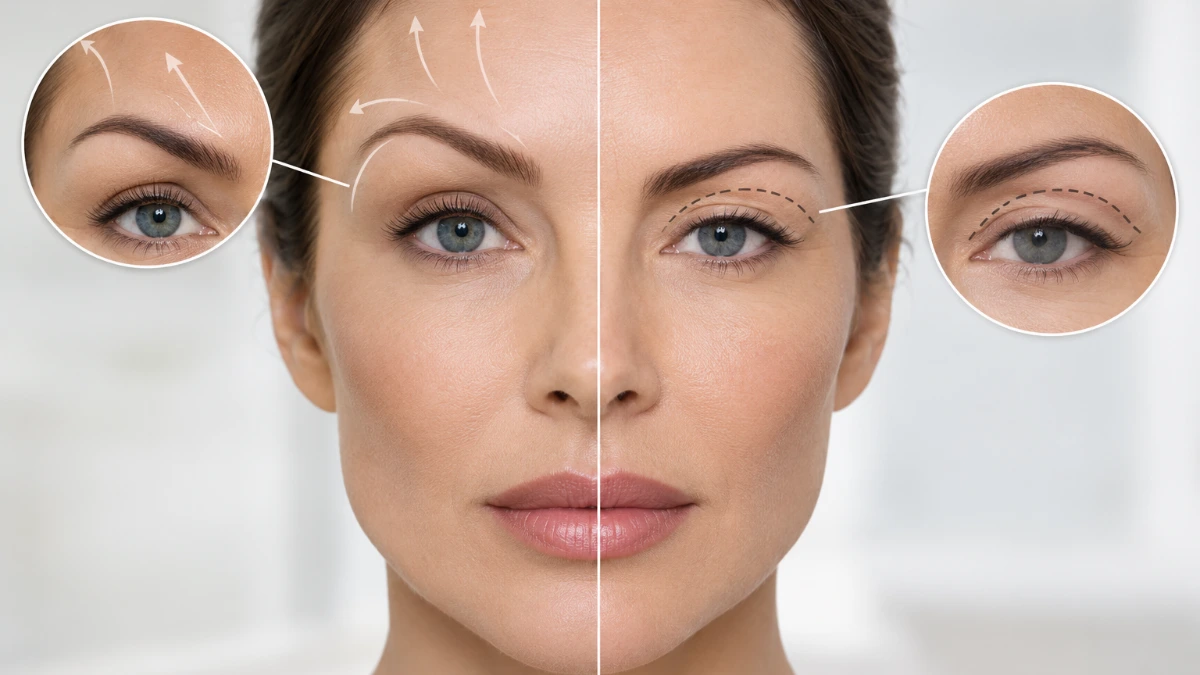
A brow lift and blepharoplasty can both change the appearance of the upper eye area, but they treat different anatomical structures. A brow lift repositions descended eyebrows and forehead tissues, while blepharoplasty treats the eyelids themselves.
This distinction matters because upper-eyelid heaviness can come from a low brow, excess eyelid skin or a combination of both. In some patients, one procedure is sufficient; in others, brow lift and blepharoplasty may be considered together.
The appropriate procedure should therefore be chosen according to where the heaviness or tissue descent originates rather than the appearance of the eyes alone.
What Is the Difference Between a Brow Lift and Blepharoplasty?
The main difference is the anatomical area being treated.
A brow lift, also called a forehead lift, repositions descended eyebrow tissues. Depending on the technique and anatomy, it can also affect the relationship between the forehead, brow and upper eyelid.
Blepharoplasty, or eyelid surgery, treats the eyelids. Upper blepharoplasty removes selected excess skin and may adjust other tissues when appropriate. Lower blepharoplasty addresses lower-eyelid concerns such as prominent under-eye bags or excess skin.
| Concern | Brow Lift | Blepharoplasty |
|---|---|---|
| Low or descended eyebrows | Yes | No |
| Excess upper-eyelid skin | May improve indirectly if caused partly by brow descent | Yes |
| Forehead position | Yes | No |
| Upper-eyelid heaviness | May help when caused by a low brow | Yes, when caused by eyelid tissue |
| Under-eye bags | No | Lower blepharoplasty may address them |
| Brow asymmetry | May be addressed in selected cases | Does not reposition the brow |
| Can procedures be combined? | Yes | Yes |
Similar-looking concerns can therefore require different procedures.
Is the Problem Your Eyelids or Your Brows?
Someone with heavy or hooded upper eyelids may assume that excess eyelid skin is the entire problem. Sometimes it is. In other patients, the eyebrow has descended and brought tissues lower over the upper eyelid.
Both changes can also occur together.
During assessment, the surgeon considers eyebrow height and shape, the amount of upper-eyelid skin, the eyelid crease, forehead anatomy and the relationship between these structures.
This distinction affects surgical planning. Removing upper-eyelid skin does not reposition a low eyebrow, while raising the brow does not directly remove genuine excess eyelid skin.
What Does Upper Blepharoplasty Correct?
Upper blepharoplasty focuses on the upper eyelid.
It may be considered when excess upper-eyelid skin creates a fold or contributes to a heavy appearance. In more pronounced cases, excess tissue can also contribute to obstruction of the upper visual field.
The incision is generally positioned within the natural upper-eyelid crease. Selected excess skin is removed, and other tissues may be adjusted when appropriate.
The objective is not to remove as much skin as possible. Sufficient tissue needs to remain for normal eyelid closure and function, so the amount removed must be planned according to the patient’s eyelid anatomy.
What Does a Brow Lift Correct?
A brow lift treats tissues above the eyelids.
It can reposition a descended eyebrow and change the relationship between the brow, forehead and upper eyelid. When a low brow contributes to upper-eyelid hooding, raising the brow may reduce some of that heaviness.
Several surgical approaches can be used, including endoscopic, temporal and hairline techniques.
The appropriate approach depends on eyebrow position, forehead anatomy, hairline and the degree and location of correction required.
Can a Low Brow Make the Upper Eyelids Look Heavy?
Yes.
As an eyebrow descends, the tissues beneath it can also move downward. This can increase fullness above the upper eyelid and create a hooded appearance.
A patient may therefore appear to have substantial excess upper-eyelid skin even when part of the problem originates from the brow.
However, not every hooded eyelid is caused by brow descent. Some patients primarily have excess eyelid skin, while others have both brow descent and eyelid changes.
Can Blepharoplasty Lift Your Eyebrows?
No. Blepharoplasty is not designed to reposition the eyebrow.
Upper blepharoplasty changes eyelid tissues rather than lifting the forehead or brow.
This becomes particularly important when a patient has both a low eyebrow and excess upper-eyelid skin. Blepharoplasty may improve the eyelid fold, but it does not directly correct the position of the eyebrow.
Can a Brow Lift Remove Excess Eyelid Skin?
Not directly.
Raising a descended eyebrow can reduce some apparent hooding by repositioning tissues above the eye. However, genuine excess upper-eyelid skin remains an eyelid issue.
A brow lift should therefore not be considered a direct replacement for blepharoplasty simply because both procedures can create a more open appearance around the upper eyes.
Brow Lift vs Blepharoplasty for Hooded Eyes
“Hooded eyes” describes an appearance rather than a single anatomical diagnosis.
Hooding may be caused primarily by:
- A low or descended eyebrow
- Excess upper-eyelid skin
- A combination of both
If brow position is the main problem, a brow lift may be considered. If excess eyelid tissue is primarily responsible, upper blepharoplasty may be more appropriate.
When both contribute significantly, the two procedures can be considered together.
Which Procedure Helps a Tired or Heavy-Eyed Appearance?
A tired appearance around the eyes can have several causes.
Excess upper-eyelid skin can contribute to heaviness, but descended eyebrows can produce a similar appearance. Under-eye bags, tear-trough changes, skin quality and individual facial anatomy may also affect how rested or tired the eyes appear.
Neither brow lift nor blepharoplasty should therefore be selected simply because the eyes “look tired.”
The anatomical feature responsible for the appearance needs to be identified first.
What Does Lower Blepharoplasty Treat?
Lower blepharoplasty addresses a different region from a brow lift.
It may be used for selected lower-eyelid concerns, including prominent fat compartments that create under-eye bags and, depending on the technique, excess lower-eyelid skin.
A brow lift does not treat under-eye bags.
Depending on the areas involved, a patient may therefore require a brow procedure, upper blepharoplasty, lower blepharoplasty or a combination.
Can Brow Lift and Blepharoplasty Be Performed Together?
Yes. The procedures may be combined when both eyebrow descent and eyelid changes contribute significantly to the patient’s concern.
This does not mean that every patient having blepharoplasty also needs a brow lift. Similarly, a low brow does not automatically mean eyelid surgery is required.
Assessing both regions allows each anatomical problem to be treated separately rather than expecting one operation to correct changes arising from several areas.
Where Are the Incisions?
Incision location differs between brow lift and blepharoplasty and also varies according to the specific technique.
Blepharoplasty Incisions
For upper blepharoplasty, the incision is generally positioned within the natural upper-eyelid crease.
Lower blepharoplasty can use different approaches. Depending on what needs to be treated, an incision may be placed below the eyelashes or on the inner surface of the lower eyelid.
Brow Lift Incisions
Brow lift incisions depend on the surgical technique.
An endoscopic brow lift typically uses several relatively small incisions within or around the hair-bearing scalp. Other approaches may place incisions near the hairline, temple or, in selected procedures, closer to the eyebrow.
Patients should therefore know which brow-lift technique is being proposed and where the resulting incisions are expected to be.
Brow Lift vs Blepharoplasty Recovery
Recovery differs because the procedures involve different tissues, although swelling and bruising can occur after either operation.
After blepharoplasty, swelling and bruising are usually concentrated around the eyelids and eyes. Temporary irritation, watering, dryness or sensitivity may also occur.
After a brow lift, swelling and bruising may involve the forehead and eyebrow region and can extend towards the eyelids. Depending on the technique, temporary tightness, numbness or altered sensation can occur around the forehead or scalp.
When brow lift and blepharoplasty are performed together, recovery needs to account for both surgical areas.
The timing of return to work, exercise and other normal activities varies according to the procedures performed, individual healing and the surgeon’s postoperative instructions.
Are the Risks Different?
Yes, although the procedures share some general surgical risks.
Both can involve risks such as bleeding, infection, scarring and reactions associated with anaesthesia.
Blepharoplasty has additional risks related to eyelid anatomy and function. These can include temporary irritation or dryness, difficulty closing the eyes, changes in eyelid position, asymmetry and, rarely, more serious eye-related complications.
Brow lift risks can include altered sensation, asymmetry, changes in the hairline, visible scarring, temporary or persistent numbness and hair changes around an incision.
Individual risk depends on anatomy, medical history, previous procedures and the surgical technique being considered.
Which Procedure Gives a More Natural Result?
Neither procedure is inherently more natural.
A result is more likely to appear appropriate when the operation addresses the anatomical structure responsible for the concern and the amount of correction suits the patient’s face.
Removing eyelid skin when the main problem is eyebrow position does not address the same issue as repositioning a low brow. Conversely, lifting the brow unnecessarily does not replace treatment of genuine excess eyelid tissue.
The decision should therefore be based on anatomy rather than choosing whichever procedure is perceived as more natural.
How Does a Surgeon Decide Between Brow Lift and Blepharoplasty?
Assessment should include the whole upper face rather than the eyelids alone.
Relevant factors may include:
- Eyebrow height and shape
- Differences between the eyebrows
- Amount and distribution of upper-eyelid skin
- Eyelid crease
- Forehead height
- Hairline position
- Skin quality
- Lower-eyelid anatomy
- Previous facial or eyelid procedures
- Eye health and relevant medical history
The patient’s desired change also matters.
Someone mainly concerned about a low outer eyebrow may require a different procedure from someone whose main concern is excess skin folding over the upper eyelid.
Can Botox Replace a Brow Lift or Blepharoplasty?
Botulinum toxin injections and surgery do not produce the same type or degree of correction.
In selected patients, injections can alter the activity of particular muscles around the eyebrow and create a subtle change in brow position.
They do not remove excess upper-eyelid skin and cannot reproduce the structural repositioning achieved with a surgical brow lift. Their effects are also temporary.
Whether a nonsurgical option is appropriate depends on the anatomy and the degree of change the patient wants.
Planning Brow or Eyelid Surgery as an International Patient
Patients travelling for facial surgery should understand which anatomical area is being treated before arranging the procedure.
Photographs taken from consistent angles and without filters can assist with preliminary assessment. However, photographs cannot fully assess eyelid function, brow movement, tissue quality or eye health.
Before travelling, patients should understand:
- Whether brow lift, blepharoplasty or both are being considered
- Whether upper, lower or both eyelids would be treated
- Which surgical technique is proposed
- Where the incisions are expected
- What early recovery may involve
- When sutures or dressings require attention
- When normal activities can gradually resume
- How follow-up will continue after returning home
The final treatment plan should be confirmed after clinical assessment.
Brow Lift and Blepharoplasty at Avicenna International Hospital
At Avicenna International Hospital in Istanbul, patients considering brow lift or blepharoplasty can be assessed according to eyebrow position, eyelid anatomy, forehead characteristics, previous procedures and the changes they want to address.
The assessment should establish whether the concern originates mainly from the brow, the eyelids or a combination of both. The proposed procedure, incision pattern and recovery plan can then be selected according to the patient’s anatomy and clinical findings.
For international patients, photographs and relevant medical information may assist with preliminary assessment before travel. Final surgical planning requires clinical evaluation.
Frequently Asked Questions
Is a Brow Lift the Same as Blepharoplasty?
No. A brow lift repositions the eyebrow and forehead tissues, while blepharoplasty operates on the eyelids.
Do I Need a Brow Lift or Upper Blepharoplasty for Hooded Eyes?
It depends on what causes the hooding. A low brow, excess upper-eyelid skin or both can contribute.
Can Blepharoplasty Raise Low Eyebrows?
No. Blepharoplasty treats eyelid tissues and is not designed to reposition a low eyebrow.
Can a Brow Lift Fix Droopy Eyelids?
A brow lift may reduce hooding caused by a descended brow, but it does not directly remove genuine excess eyelid skin.
Can I Have a Brow Lift and Blepharoplasty at the Same Time?
Yes. They may be combined when both eyebrow descent and eyelid changes contribute significantly to the concern.
Is Brow Lift Recovery Longer Than Blepharoplasty Recovery?
Not necessarily. Recovery depends on the brow-lift technique, which eyelids are treated, whether procedures are combined and individual healing.
Does Blepharoplasty Treat Under-Eye Bags?
Lower blepharoplasty can address selected forms of under-eye bags and lower-eyelid tissue changes. A brow lift does not treat under-eye bags.
Will a Brow Lift Change My Eye Shape?
A brow lift primarily changes eyebrow position and the tissues above the eyes. The eye area may look different because the relationship between the brow and upper eyelid changes, but it is not primarily an eye-shape operation.
Which Is Better: Brow Lift or Blepharoplasty?
Neither is universally better. The appropriate procedure depends on whether the concern originates mainly from eyebrow position, eyelid tissues or both.