
Scarring is an unavoidable part of breast lift surgery because the procedure requires incisions to remove excess skin and reshape the breast. What varies between patients is the location, length, and eventual appearance of those scars.
A smaller lift may require an incision mainly around the areola, while more extensive reshaping can require a vertical incision or an additional incision along the breast crease. The appropriate technique should therefore be selected according to the correction required rather than simply choosing the option with the shortest scar.
Breast lift scars are usually most noticeable during early healing. They can gradually become flatter, softer, and less visible as they mature, but they do not disappear completely.
Where Are Breast Lift Scars Located?
Breast lift scars can appear in three main areas: around the areola, vertically between the areola and breast crease, and along the fold underneath the breast.
The exact combination depends on how much skin needs to be removed and how far the breast and nipple need to be repositioned.
An incision around the areola follows the transition between the areola and surrounding breast skin. An incision beneath the breast can sit within the natural breast crease. A vertical incision is more exposed because it runs across the lower part of the breast.
The appropriate scar pattern is determined by the amount of reshaping required rather than scar length alone.
What Are the Different Types of Breast Lift Scars?
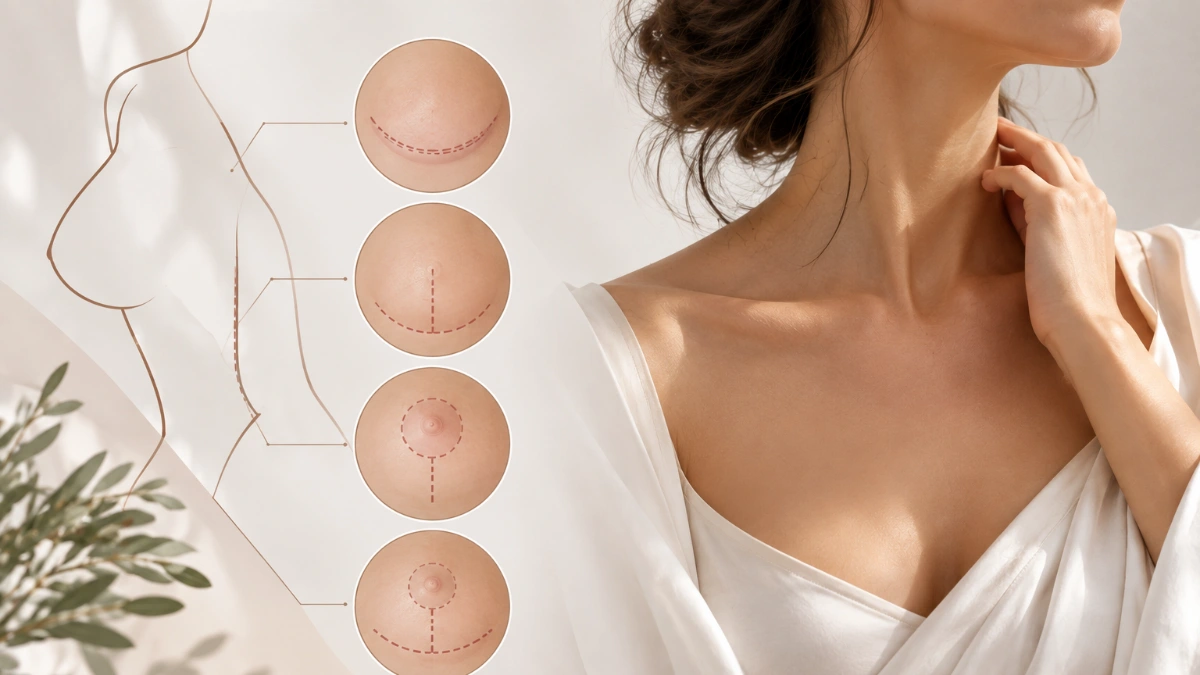
Breast lift techniques are commonly described according to the pattern created by their incisions.
Crescent Scar
A crescent lift uses a short incision along part of the upper border of the areola.
It produces relatively limited scarring but also allows only a modest degree of correction. It is therefore used selectively and is not an alternative to a more extensive breast lift when significant sagging or excess skin is present.
Periareolar or Donut Scar
A periareolar lift uses an incision around the areola.
Once healed, the scar lies along the transition between the darker areola and surrounding breast skin, which can make its location less noticeable in some patients.
This approach allows more correction than a limited crescent incision but still has limitations when a larger amount of loose skin needs to be removed.
Vertical or Lollipop Scar
A vertical breast lift uses an incision around the areola together with a vertical incision extending from the lower edge of the areola toward the breast crease.
This creates the characteristic lollipop-shaped scar.
The additional vertical incision gives the surgeon greater ability to remove excess skin and reshape the breast. It may therefore be used when more correction is required than can be achieved with an incision around the areola alone.
Anchor or Inverted-T Scar
An anchor breast lift includes an incision around the areola, a vertical incision down the lower breast, and a horizontal incision along the breast crease.
This creates the most extensive scar pattern of the commonly used breast lift techniques.
The longer incision allows greater skin removal and breast reshaping and may be necessary when there is considerable sagging or excess skin.
Which Breast Lift Has the Smallest Scar?
Crescent and periareolar techniques generally produce shorter scars than vertical or anchor breast lifts.
However, the shortest scar is not automatically the most appropriate choice.
A limited incision also limits how much skin can be removed and how extensively the breast can be reshaped. Trying to avoid a vertical or horizontal scar when more substantial correction is required may compromise the surgical plan.
Breast shape, skin excess, nipple position, tissue quality, and the degree of lifting required should determine the incision pattern.
For this reason, a more useful question is often: which incision pattern is necessary to achieve the correction my breasts require?
What Do Breast Lift Scars Look Like After Surgery?
New breast lift scars are usually more noticeable than mature scars.
During early recovery, an incision may appear pink, red, or darker than the surrounding skin. It may also feel firm or look slightly raised. Swelling can make the incision and surrounding tissues appear more prominent.
These early changes do not represent the final appearance of the scar.
As healing progresses, redness may decrease, firmness can soften, and the scar may gradually become flatter and less noticeable.
Scar maturation is slow and can continue for many months. Changes may continue beyond the first year after surgery.
Do Breast Lift Scars Completely Disappear?
No. Breast lift scars are permanent.
A well-healed scar may eventually become a relatively fine and inconspicuous line, but the skin does not return completely to its appearance before the incision is made.
The final appearance varies considerably between patients. Some scars fade particularly well, while others remain more visible because they become wider, darker, lighter, raised, or thicker than the surrounding skin.
It is therefore not possible to guarantee exactly how a breast lift scar will eventually look.
Why Do Some Breast Lift Scars Heal Better Than Others?
Scar formation is affected by both the operation and the patient’s individual healing response.
Factors that may influence the final appearance include:
- Skin characteristics
- Individual tendency to develop prominent scars
- Tension across the incision
- Wound-healing problems
- Infection
- Smoking
- Sun exposure
- Location of the incision
- Postoperative care
Tension on a healing incision can be particularly relevant. Returning to strenuous activity too early may place unnecessary stress on the wound.
Patients should therefore follow postoperative activity restrictions even if they feel physically able to do more.
Does a Bigger Breast Lift Mean a Bigger Scar?
More extensive breast reshaping often requires longer incisions, although there is no simple relationship between breast size and scar length.
A patient with mild sagging and relatively little excess skin may be suitable for a limited-incision technique. Someone with considerable skin excess may require a vertical or anchor pattern to reshape the breast adequately.
Breast size is only one factor. Nipple position, skin elasticity, breast shape, tissue distribution, and the amount of excess skin also influence the technique.
Two patients with similarly sized breasts may therefore require different incision patterns.
Breast Lift Scars After Pregnancy or Weight Loss
Pregnancy, breastfeeding, and substantial weight loss can change the breast envelope.
The skin may become looser, breast tissue may lose volume, and the nipple can sit lower on the breast. When these changes are pronounced, more skin may need to be removed during a breast lift.
A vertical or anchor incision may therefore be more appropriate than a limited periareolar technique.
Patients who have lost a large amount of weight may also have thinner or less elastic tissues. These characteristics need to be considered when planning both breast shape and the incision pattern.
How Can Breast Lift Scars Differ Between Skin Tones?
Scar color does not develop in exactly the same way in every skin tone.
During healing, some scars become darker than the surrounding skin, while others may eventually appear lighter. Pigmentation differences can sometimes remain visible after the scar has matured.
A patient’s previous scars can provide useful information about how their skin tends to heal.
Anyone with a history of thick, raised, or keloid scars should discuss this with the surgeon before breast lift surgery. Previous abnormal scarring cannot predict exactly how a new incision will heal, but it is relevant when discussing expectations and postoperative scar management.
How Should You Care for Breast Lift Scars?
Scar care begins with appropriate wound care.
During early recovery, the priority is allowing the incision to close and heal. Patients should follow their surgical team’s instructions for dressings, showering, support garments, and physical activity.
Scar products should not be applied to an open or incompletely healed incision unless specifically advised.
Once the wound has healed sufficiently, the postoperative plan may include:
- Silicone gel or silicone sheets
- Protection from sun exposure
- Appropriate breast support
- Scar massage when recommended
- Continued observation of the incision
The appropriate timing differs between patients and should follow the surgical team’s instructions.
Can Silicone Gel or Silicone Sheets Help Breast Lift Scars?
Silicone products are commonly used as part of postoperative scar management.
They do not make a surgical scar disappear. Their purpose is to support scar management and may include helping with characteristics such as excessive thickness or firmness in appropriate cases.
Silicone is available in forms including gels and sheets.
The incision should be sufficiently healed before these products are introduced. Silicone products should not be applied to a fresh or open surgical wound unless specifically instructed.
Should Breast Lift Scars Be Protected From the Sun?
Sun protection is particularly relevant while scars are still maturing.
Healing scars can respond differently to ultraviolet exposure than the surrounding skin, potentially making pigmentation differences more noticeable.
Breast lift scars are usually covered by clothing, but some may become exposed when wearing swimwear or low-cut clothing.
Once an incision has healed sufficiently for sunscreen to be used, protecting exposed scars from strong sunlight can help reduce avoidable color changes during maturation.
Should You Massage Breast Lift Scars?
Scar massage may be recommended during recovery, but it should not be started automatically immediately after surgery.
A fresh incision needs time to close and heal. Manipulating it too early can interfere with the wound.
If massage is appropriate, the surgical team can advise when to start and how it should be performed.
Patients should not aggressively massage an incision that is painful, opening, swollen, or showing signs of a wound problem.
When Should a Breast Lift Scar Be Checked?
Some redness, firmness, and visibility are expected while a surgical scar is forming. What matters is whether the incision is progressing normally or developing new problems.
Patients should contact their surgical team if they notice:
- Increasing rather than improving redness
- Separation of the wound
- Fluid or pus from the incision
- Increasing warmth or swelling
- Fever
- Worsening pain
- Persistent wound-healing problems
- A scar becoming increasingly thick or raised
These findings can have different causes and may require clinical assessment rather than routine scar care alone.
What Are Hypertrophic Scars and Keloids?
A scar that becomes thick and raised may represent abnormal scar formation.
A hypertrophic scar is raised but remains within the boundaries of the original incision.
A keloid extends beyond the margins of the original wound.
They are different forms of abnormal scarring and may require different management. Patients with a previous history of hypertrophic or keloid scars should discuss this before surgery.
Not every red, firm, or slightly raised scar during early recovery is abnormal. Normal surgical scars can remain noticeable while they are still maturing.
Can Breast Lift Scars Be Revised?
Sometimes a scar remains noticeably wide, raised, irregular, or otherwise problematic after healing.
Depending on the characteristics of the scar, treatment may involve nonsurgical scar management or surgical revision. The appropriate approach depends on whether the main concern is color, thickness, width, texture, or scar position.
Surgical scar revision does not remove a scar completely. It creates a new incision with the aim of producing a more favorable scar.
Before revision is considered, it is important to assess why the original scar healed poorly and whether another procedure is likely to improve its appearance.
Breast Lift Scars vs. Breast Augmentation Scars
The Breast augmentation and breast lift surgery produce different scar patterns because the procedures have different purposes.
Breast augmentation primarily adds volume using an implant. The incision required to place an implant is therefore generally more limited than the incisions required to remove excess skin during a breast lift.
A breast lift reshapes the breast envelope and repositions the nipple. When substantial lifting is required, longer incisions may be necessary.
Some patients need both procedures. When breast augmentation and a lift are performed together, the scar pattern is determined mainly by the amount of lifting and skin removal required, together with the planned implant procedure.
Can You Have a Breast Lift Without Implants?
Yes. Breast lift surgery and breast augmentation are separate procedures.
A breast lift primarily changes breast position and shape by reshaping existing tissue and removing excess skin. A breast implant primarily adds volume.
Some patients have sufficient existing breast volume and want only to improve breast position and shape. Others want both lifting and additional volume.
Whether an implant is appropriate depends on the patient’s anatomy and desired change rather than being an automatic part of breast lift surgery.
Planning a Breast Lift as an International Patient
Patients travelling for breast lift surgery should understand the expected incision pattern before making final treatment and travel arrangements.
Photographs can assist with preliminary planning, but they cannot show every factor that affects the surgical technique. Skin elasticity, tissue quality, breast measurements, and nipple position are better assessed clinically.
Before surgery, international patients should understand:
- Which incision pattern is being considered?
- Where the scars are expected to be
- How the wounds should be cared for
- When showering is permitted
- How long breast support may be required
- When normal activities can gradually resume
- When scar treatments can begin
- How follow-up will continue after returning home
This is particularly important because scar maturation continues long after the initial surgical recovery period.
Breast Lift Surgery at Avicenna International Hospital
At Avicenna International Hospital in Istanbul, breast lift planning begins with assessment of breast shape, skin excess, nipple position, tissue characteristics, and the patient’s desired change.
The incision pattern is selected according to the amount of lifting and reshaping required. The expected position of the resulting scars should therefore be discussed as part of the surgical plan rather than after the technique has been selected.
For international patients, photographs and available medical information may assist with preliminary assessment before travel. The final breast lift technique and treatment plan are determined after clinical evaluation.
Frequently Asked Questions
Are Breast Lift Scars Permanent?
Yes. Breast lift scars are permanent, although they generally become less noticeable as they mature.
What Is a Lollipop Breast Lift Scar?
A lollipop scar consists of a circular scar around the areola and a vertical scar extending from the areola toward the breast crease.
What Is an Anchor Breast Lift Scar?
An anchor scar runs around the areola, vertically down the lower breast and horizontally along the breast crease. It is generally used when more extensive skin removal and reshaping are required.
How Long Do Breast Lift Scars Take to Fade?
There is no precise timetable. Scars change gradually over many months, and maturation can continue beyond the first year.
Can I Have a Breast Lift Without a Vertical Scar?
Some patients are suitable for a limited-incision breast lift. However, avoiding a vertical scar is not appropriate when that incision is needed to remove sufficient skin and reshape the breast.
Can Breast Lift Scars Be Hidden Under a Bra?
The horizontal scar from an anchor lift sits within the breast crease and may be concealed by many bras. Scars around the areola and vertically down the breast are positioned higher and may be visible depending on clothing.
Does Silicone Gel Remove Breast Lift Scars?
No. Silicone gel does not erase surgical scars. It may be used as part of scar management once the incision has healed sufficiently.
Can Breast Lift Scars Become Keloids?
Yes, keloids can develop in susceptible individuals. A previous history of keloid or other problematic scarring should be discussed before surgery.
Is a Breast Lift Worth the Scars?
This is an individual decision. Breast lift surgery can change breast position and shape, but it requires permanent incisions. The expected improvement and likely scar pattern should both be understood before deciding whether the trade-off is acceptable.