
A blocked nose is not always caused by a deviated septum or sinus infection. In some patients, the obstruction comes from enlarged turbinates; in others, nasal polyps are responsible.
Both can restrict airflow and occur with inflammation, but they are different conditions and do not necessarily require the same treatment.
Persistent congestion, reduced sense of smell or one-sided blockage can provide clues, but symptoms alone cannot reliably identify which structure is causing the problem.
The more useful question is whether the obstruction comes from swollen normal nasal tissue, a separate inflammatory growth or a combination of problems.
Nasal Polyps vs Enlarged Turbinates: Quick Answer
Enlarged turbinates are normal structures inside the nose that have become swollen or enlarged. Nasal polyps are separate, usually benign inflammatory growths arising from the nasal or sinus lining. Both can cause nasal obstruction, but symptoms alone cannot reliably distinguish them. ENT examination, sometimes including nasal endoscopy, helps identify the cause. Treatment depends on whether the problem involves inflammation, structural enlargement, polyps or a combination.
Nasal Polyps vs Enlarged Turbinates: Key Differences
| Feature | Enlarged Turbinates | Nasal Polyps |
|---|---|---|
| What they are | Normal nasal structures that have become enlarged | Inflammatory growths arising from the nasal or sinus lining |
| Typical location | Along the side walls of the nose | Often deeper in the nasal cavity and around sinus drainage pathways |
| Main effect | Narrowing of the nasal airway | Nasal obstruction and sometimes impaired sinus drainage |
| Common associations | Allergic or non-allergic rhinitis, chronic irritation, structural changes | Chronic rhinosinusitis and persistent inflammation |
| Symptom pattern | Congestion may fluctuate | Obstruction may be more persistent |
| Reduced sense of smell | Possible | Common, particularly with extensive disease |
| Assessment | Nasal examination, sometimes endoscopy | Nasal examination and often endoscopy |
| Treatment | Medical therapy; selected turbinate procedures | Anti-inflammatory treatment; selected sinus procedures |
These are general patterns rather than diagnostic rules. A patient can also have enlarged turbinates and nasal polyps at the same time.
What Are Nasal Turbinates and Why Do They Become Enlarged?
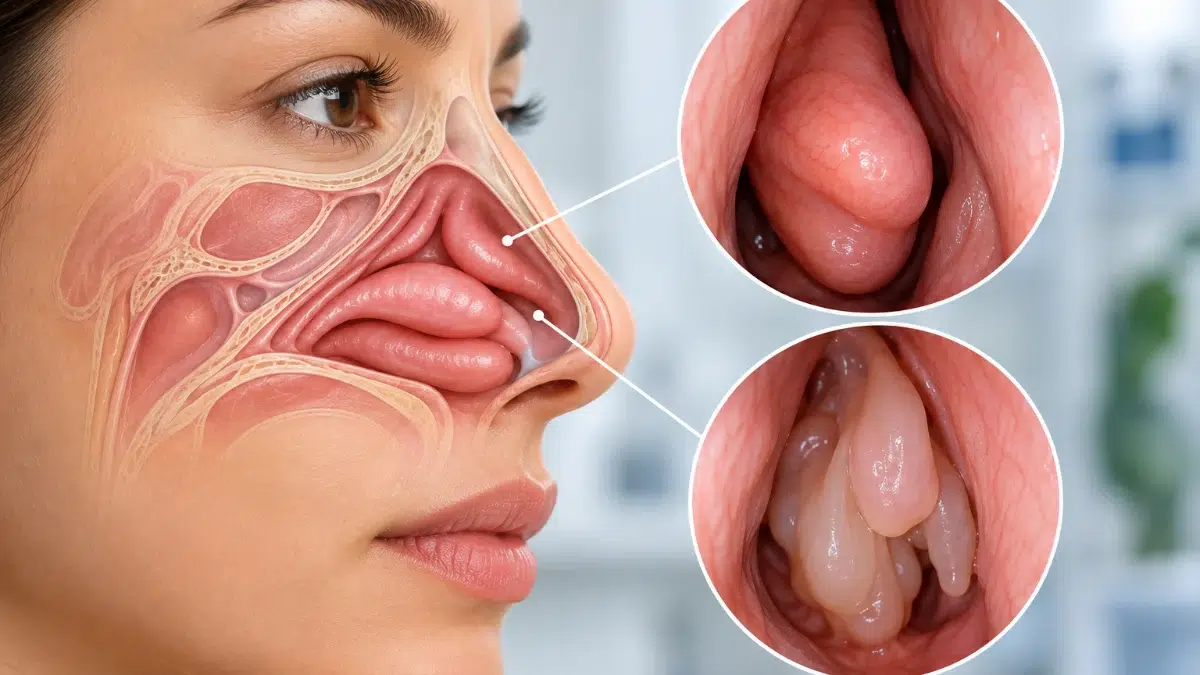
Turbinates are normal structures attached to the side walls inside the nose.
They contain bone covered by vascular soft tissue and mucosa. Their functions include warming, humidifying and filtering inhaled air.
There are three main pairs: inferior, middle and superior turbinates.
The inferior turbinates are particularly important in nasal obstruction because they occupy part of the lower nasal airway.
Their soft tissues naturally change in volume throughout the day. When inflammation or structural enlargement causes excessive swelling, breathing can become difficult.
This is commonly called turbinate hypertrophy.
Possible contributing factors include:
- Allergic or non-allergic rhinitis
- Chronic nasal irritation or inflammation
- Changes associated with a deviated septum
- Certain medication-related nasal conditions
- Structural enlargement of the turbinate
Not every enlarged turbinate is caused by allergy.
Some patients mainly have reversible soft-tissue swelling, while others have a more substantial structural component. This distinction matters because medical treatment may improve inflammatory enlargement without surgery.
What Are Nasal Polyps?
Nasal polyps are soft, usually benign inflammatory growths that develop from the lining of the nose or sinuses.
They are commonly associated with chronic rhinosinusitis with nasal polyps.
Small polyps may cause few symptoms. Larger or multiple polyps can interfere with nasal airflow, sinus drainage and the sense of smell.
Patients may notice persistent congestion, nasal discharge or a feeling that the nose is continuously blocked.
Nasal polyps can also occur in people with asthma or other inflammatory conditions.
However, nasal polyps are not simply another name for ordinary allergic nasal swelling.
Can a Swollen Turbinate Look Like a Nasal Polyp?
Yes, particularly to someone looking inside their own nose.
An enlarged inferior turbinate may appear as a rounded swelling near the front of the nasal passage.
A patient may therefore mistake a normal but swollen anatomical structure for an abnormal growth.
The reverse can also happen: a visible mass may be assumed to be a turbinate when it is something else.
During examination, an ENT specialist considers the structure’s location, attachment, shape, appearance and surrounding tissue.
Typical inflammatory polyps often appear pale or translucent, while turbinates are normal mucosa-covered structures. Inflammation, however, can change the appearance of both.
Colour and appearance alone are not reliable enough for self-diagnosis.
Can Symptoms Tell the Difference?
Symptoms provide clues, but they overlap considerably.
Congestion That Changes Sides
Turbinates naturally change in size through the nasal cycle.
When they are enlarged or inflamed, these changes become more noticeable. One nostril may feel blocked in the morning and the other later in the day.
This pattern can suggest a turbinate contribution but does not exclude another cause.
Persistent Blockage and Reduced Smell
Nasal polyps can cause continuous obstruction and are often associated with reduced or lost sense of smell.
However, smell can also be affected by other inflammatory nasal and sinus conditions.
Reduced smell alone cannot confirm polyps.
Sneezing, Itching and Watery Discharge
These symptoms are more suggestive of an allergic component.
Allergic inflammation commonly affects the turbinates, but allergy can coexist with polyps or other nasal conditions.
More than one diagnosis may therefore be relevant.
What If Only One Nostril Is Blocked?
Persistent or progressively worsening one-sided obstruction deserves particular attention.
Possible causes include septal deviation, asymmetric turbinate enlargement, local inflammation or a unilateral polyp.
However, not every one-sided nasal mass is an ordinary inflammatory polyp.
Medical assessment is particularly important when obstruction is associated with:
- Repeated unexplained bleeding
- A visible or unusual mass
- Progressive symptoms
- Pain
- Other concerning changes
Patients should not attempt to pull, cut or manipulate a visible nasal growth.
How Does an ENT Specialist Tell Polyps From Turbinates?
Assessment begins with the history and symptom pattern.
The ENT specialist may ask whether congestion is constant or intermittent, whether it alternates between sides, whether smell has changed and whether allergy symptoms are present.
Previous nasal operations, medications and longstanding sinus problems can also be relevant.
Examination may assess the septum, inferior and middle turbinates, nasal lining, sinus drainage areas and the presence of polyps or other masses.
The important step is identifying which structure is actually narrowing the airway.
Why Is Nasal Endoscopy Useful?
Nasal endoscopy allows the specialist to examine areas that cannot always be seen by looking through the nostrils alone.
A thin endoscope provides a direct view of the nasal cavity and important sinus drainage regions.
It may help identify polyps, enlarged turbinates, adhesions, discharge, inflammation or other abnormalities.
Endoscopy can be especially useful when symptoms suggest polyps but none are visible during a basic examination.
Not every patient with congestion requires the same examination. The decision depends on the symptoms and clinical findings.
Can a Decongestant Help Identify Turbinate Swelling?
Sometimes.
During an ENT examination, a topical decongestant may be used to assess how much an enlarged turbinate reduces in size.
If it shrinks significantly, this may suggest that reversible soft-tissue swelling contributes to the obstruction.
However, response to a decongestant is not a definitive test for distinguishing enlarged turbinates from polyps.
Fixed structural narrowing may remain, and other inflamed tissues can also respond.
Patients should not repeatedly use over-the-counter decongestant sprays to diagnose themselves. Prolonged use of certain sprays can cause rebound congestion.
Do You Need a CT Scan?
Not always.
Many nasal conditions can be assessed through medical history, examination and nasal endoscopy.
CT imaging may be useful when chronic sinus disease is suspected, nasal polyps appear extensive, deeper anatomy needs evaluation or surgery is being planned.
It provides information about areas that cannot be fully examined directly.
However, CT should answer a clinical question rather than being ordered automatically for every blocked nose.
Can You Have Nasal Polyps and Enlarged Turbinates Together?
Yes.
Nasal obstruction often involves more than one problem.
For example, a patient with chronic rhinosinusitis and nasal polyps may also have enlarged inferior turbinates, a deviated septum or allergic rhinitis.
Treating one finding does not always address the entire cause of obstruction.
This does not mean every abnormality requires surgery. The ENT specialist needs to determine which findings contribute meaningfully to the symptoms.
How Are Enlarged Turbinates Treated?
Treatment depends on whether enlargement is mainly inflammatory, structural or a combination.
When inflammation is important, management may include appropriate nasal medication and treatment of allergic or non-allergic rhinitis.
If substantial enlargement continues to restrict airflow despite suitable medical management, a turbinate procedure may be considered.
Different techniques aim to reduce turbinate volume while preserving normal nasal function.
The objective is to improve airflow without unnecessarily removing tissue that helps warm and humidify inhaled air.
Turbinate surgery is not automatically needed simply because the turbinates appear enlarged.
How Are Nasal Polyps Treated?
Treatment focuses on controlling inflammation as well as managing the extent of nasal and sinus disease.
Depending on the diagnosis, options may include:
- Saline irrigation
- Intranasal corticosteroid treatment
- Short courses of systemic corticosteroids in selected cases
- Other specialist anti-inflammatory treatments
- Biologic treatment for selected patients with severe chronic rhinosinusitis with nasal polyps
If symptoms remain substantial despite appropriate medical management, endoscopic sinus surgery may be considered.
Surgery can remove polyps and improve access to affected sinus drainage pathways. However, it does not necessarily eliminate the underlying inflammatory tendency.
Polyps may recur, so ongoing medical management and follow-up can remain important.
For more information, see our Nasal Polyps Treatment in Turkey guide.
Turbinate Surgery vs Nasal Polyp Surgery: Are They the Same?
No. They address different problems.
Turbinate reduction aims to decrease the volume of enlarged turbinate tissue while preserving its normal function.
Nasal polyp surgery removes inflammatory growths and may form part of endoscopic sinus surgery when associated sinus disease is present.
A patient may require assessment of both conditions, but finding one does not automatically mean surgery for the other is necessary.
The procedure should match the diagnosis.
What If You Still Cannot Breathe After Septoplasty?
Septoplasty corrects a deviated nasal septum. It does not treat every possible cause of nasal obstruction.
A patient may remain congested because of enlarged turbinates, nasal polyps, allergic or non-allergic rhinitis, nasal valve problems or postoperative swelling during early recovery.
Persistent obstruction should be evaluated according to the stage of healing and the structures involved.
Repeating septoplasty is not automatically appropriate when another part of the nasal airway is responsible.
When Should a Blocked Nose Be Investigated Promptly?
Nasal congestion is common, but some findings deserve medical assessment rather than prolonged self-treatment.
These include:
- Persistent or progressive one-sided obstruction
- Recurrent unexplained nosebleeds
- A new or unusual nasal mass
- Significant or worsening facial pain
- Persistent loss of smell
- Symptoms that do not improve with appropriate treatment
Visual changes, swelling around the eye, severe headache with concerning neurological symptoms or significant systemic illness may require urgent medical evaluation.
These findings do not establish a diagnosis, but they can change how quickly assessment is needed.
What Should You Ask During an ENT Consultation?
Useful questions include:
- Is my obstruction caused by enlarged turbinates, polyps or another problem?
- Does the nasal lining appear inflamed?
- Is nasal endoscopy necessary?
- Could allergies or chronic rhinosinusitis contribute?
- Is there evidence of another nasal mass?
- Should medical treatment be tried before surgery?
- If surgery is recommended, which structure will be treated?
- Could the condition recur?
- Will I need long-term medication or follow-up?
Understanding the cause is more useful than choosing a procedure based only on the sensation of having a blocked nose.
Nasal Polyps and Turbinate Problems at Avicenna International Hospital
Avicenna International Hospital in Istanbul provides ENT services for nasal obstruction, sinus disease and related conditions.
The hospital’s published information includes turbinate procedures, nasal polyp surgery and endoscopic sinus surgery among its ENT services.
These procedures address different anatomical and inflammatory problems. Appropriate treatment depends on identifying the cause of obstruction rather than assuming that every blocked nose requires the same intervention.
For international patients, previous ENT reports, imaging and treatment records may assist with preliminary review. Photographs of the nostrils alone cannot reliably determine what is causing deeper nasal obstruction.
Final diagnosis and treatment planning require appropriate clinical examination.
For more information about available services, visit Avicenna’s ENT Center and ENT Department.
Frequently Asked Questions
Are Enlarged Turbinates the Same as Nasal Polyps?
No. Turbinates are normal nasal structures that can become enlarged, while polyps are separate inflammatory growths.
Can an Enlarged Turbinate Look Like a Polyp?
Yes. An enlarged turbinate may appear as a rounded swelling inside the nose. Examination is needed to distinguish it from a separate growth.
Which Causes More Loss of Smell?
Nasal polyps and chronic rhinosinusitis commonly affect smell, but other nasal conditions can also reduce it.
Can Allergies Cause Nasal Polyps?
Polyps are associated with chronic inflammation and may coexist with allergies, but allergic rhinitis and nasal polyposis are different conditions.
Can Enlarged Turbinates Be Treated Without Surgery?
Often, particularly when inflammation contributes to enlargement. Medical treatment is generally considered before a turbinate procedure where appropriate.
Can Nasal Polyps Be Treated Without Surgery?
Yes. Anti-inflammatory treatment can improve symptoms in some patients. Surgery may be considered when medical management does not provide sufficient control.
Will Removing Nasal Polyps Cure the Problem Permanently?
Not necessarily. Polyps can recur because the underlying inflammatory condition may persist.
Do I Need Surgery If I Have Both Conditions?
Not automatically. Treatment depends on which findings cause symptoms and how the conditions respond to medical management.
Can a CT Scan Tell the Difference?
CT provides useful information about nasal and sinus anatomy, but direct examination and nasal endoscopy are often important in identifying the cause of obstruction.