

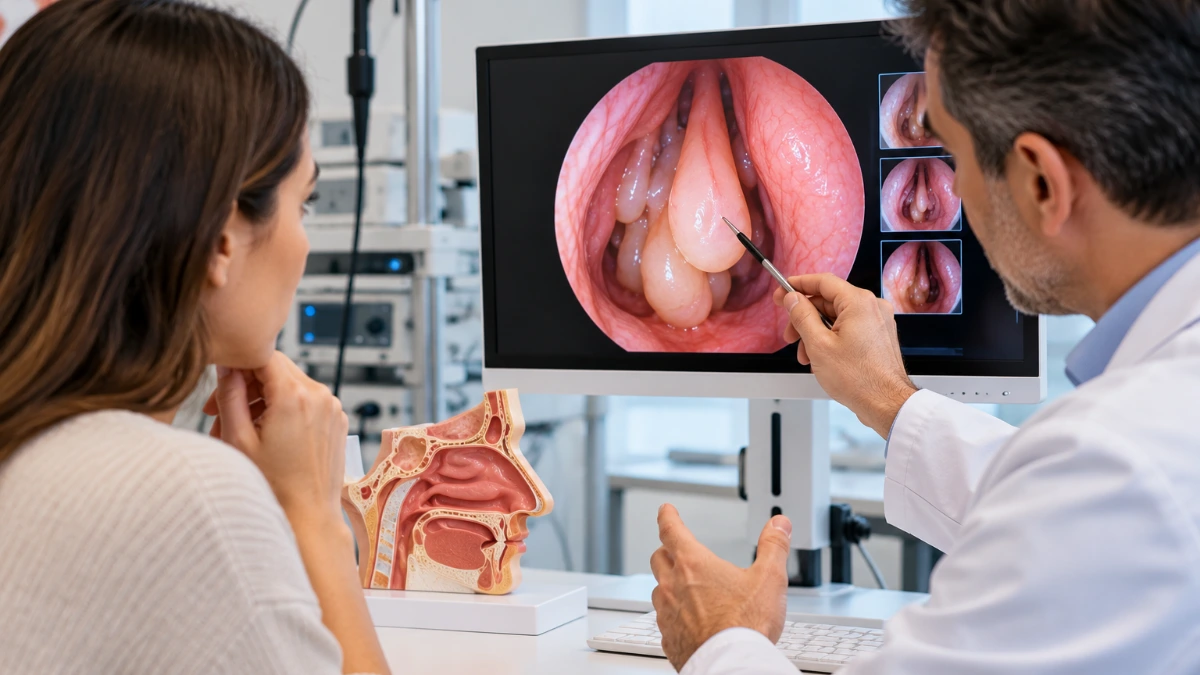
Nasal polyp surgery can improve breathing, reduce congestion and help restore the sense of smell, but some patients notice symptoms returning months or years later.
That does not automatically mean that the original surgery was unsuccessful. Nasal polyps are often associated with chronic inflammation of the nose and sinuses, and that inflammatory tendency can remain active even after visible polyps have been removed.
When symptoms return, the important question is whether the cause is recurrent polyps, ongoing inflammation, postoperative changes or another nasal problem.
Nasal Polyps After Surgery: Quick Answer
Nasal polyps can return after surgery because the underlying inflammation may remain active even after the visible growths are removed. Recurrence is more likely in some patients with severe chronic rhinosinusitis, asthma or aspirin-exacerbated respiratory disease. However, returning congestion does not always mean that polyps have regrown. ENT examination, often including nasal endoscopy, helps determine whether medical treatment, revision surgery or another approach is appropriate.
Why Do Nasal Polyps Return After Surgery?
Many patients with nasal polyps have chronic rhinosinusitis with nasal polyps, often abbreviated as CRSwNP.
This is a chronic inflammatory condition affecting the lining of the nose and sinuses.
Endoscopic sinus surgery can remove obstructing polyps and improve access to affected sinus pathways. However, it does not necessarily eliminate the inflammation that allowed the polyps to develop.
If that inflammation persists or becomes active again, new polyps may develop or remaining small polyps may enlarge.
This distinction is important:
Removing the polyps and controlling the disease that produces polyps are not the same thing.
Some patients remain well controlled for years after surgery. Others experience recurrent inflammation or polyp growth despite an appropriate operation.
Recurrence therefore does not automatically mean that the first surgery failed.
Are Returning Symptoms Always Caused by Polyps?
No.
A blocked nose after surgery can have several explanations.
| Symptom or finding | Possible explanation |
|---|---|
| Congestion during early recovery | Swelling or crusting |
| Gradually returning blockage with reduced smell | Recurrent inflammation or polyps |
| Sneezing and itching | Allergic rhinitis |
| Persistent one-sided obstruction | Scar tissue, structural narrowing or another cause |
| Ongoing sinus symptoms | Poorly controlled chronic rhinosinusitis |
| New bleeding or an unusual mass | A problem requiring further investigation |
Symptoms alone cannot establish the diagnosis.
For example, enlarged turbinates can cause nasal blockage without recurrent polyps being present.
Our Nasal Polyps vs Enlarged Turbinates guide explains how these conditions differ.
Who Has a Higher Risk of Nasal Polyp Recurrence?
Recurrence risk is not the same for every patient. Certain clinical patterns may be associated with more persistent disease.
Asthma
Patients with asthma and nasal polyps may have inflammation affecting both the upper and lower airways.
Asthma does not mean polyps will definitely return, but it can be relevant when assessing disease severity and long-term control.
Aspirin-Exacerbated Respiratory Disease
Some patients have a condition involving asthma, nasal polyps and respiratory reactions to aspirin or certain other anti-inflammatory medicines.
This is called aspirin-exacerbated respiratory disease (AERD).
Patients with AERD may experience more persistent or recurrent nasal polyp disease.
A history of breathing reactions to aspirin or other nonsteroidal anti-inflammatory medicines should be discussed with the treating specialist.
Patients should never attempt aspirin exposure or desensitization without appropriate medical supervision.
Severe or Previously Recurrent Disease
Patients with extensive inflammatory disease or previous polyp operations may require closer long-term management.
However, previous surgery alone does not determine whether another operation will be necessary.
Current symptoms, examination findings and response to treatment remain important.
How Soon Can Nasal Polyps Return?
There is no single timeline.
Some patients maintain good symptom control for years, while others develop recurrent disease sooner.
Nasal blockage shortly after surgery is often related to healing rather than polyp recurrence. Swelling, crusting and temporary inflammation can restrict airflow during recovery.
Symptoms that return months or years later may raise greater concern about recurrent inflammation or polyps, but another cause may still be responsible.
Timing needs to be interpreted together with breathing, sense of smell, discharge and examination findings.
Why Is Medical Treatment Important After Surgery?
Surgery and medical treatment often have different roles.
Surgery removes obstructing polyps and addresses relevant sinus anatomy. Medical treatment focuses on controlling inflammation that may continue afterwards.
Depending on the diagnosis, postoperative management may include:
- Saline irrigation
- Prescribed intranasal corticosteroids
- Follow-up examinations
- Management of associated asthma or inflammatory conditions
- Treatment adjustments when symptoms return
Patients should follow their surgeon’s instructions about when to begin or continue postoperative nasal treatment.
Stopping prescribed medication simply because breathing has improved may not be appropriate for patients who require long-term inflammation control.
How Does an ENT Specialist Confirm That Polyps Have Returned?
The first step is to establish whether recurrent polyps are actually present.
The specialist may review the original operation, previous endoscopy findings, imaging, medication history and current symptoms.
Examination may assess the nasal lining, degree of inflammation, recurrent or residual polyps, crusting, scar tissue, adhesions and other causes of obstruction.
Why Is Nasal Endoscopy Useful?
Nasal endoscopy allows the ENT specialist to examine areas that are difficult to see during a basic nasal examination.
A thin endoscope can help identify recurrent polyps, inflammation, enlarged turbinates, adhesions or other abnormalities.
This matters because not every structure causing nasal obstruction is a polyp.
Endoscopy can therefore help distinguish recurrent disease from another reason for blockage.
Is Another CT Scan Necessary?
Not always.
CT imaging may be useful when the extent of sinus disease needs assessment, symptoms remain unexplained or revision surgery is being considered.
However, imaging should answer a clinical question rather than being repeated automatically whenever congestion returns.
Do Recurrent Nasal Polyps Always Need Another Operation?
No.
Finding recurrent polyps does not automatically mean revision surgery is necessary.
The ENT specialist may consider:
- Severity of symptoms
- Extent of recurrent disease
- Response to appropriate medical treatment
- Associated asthma or inflammatory conditions
- Previous surgical findings
- Whether another operation would meaningfully improve the current problem
A small recurrent polyp causing few symptoms may require a different approach from extensive disease associated with severe obstruction and loss of smell.
Treatment should focus on controlling the disease rather than operating simply because a polyp is visible.
How Are Recurrent Nasal Polyps Treated?
Treatment depends on disease severity, previous management and current symptoms.
| Clinical situation | Possible approach |
|---|---|
| Mild recurrence with manageable symptoms | Continued or adjusted topical treatment |
| Significant inflammatory symptoms | Specialist review of anti-inflammatory therapy |
| Persistent obstruction despite appropriate treatment | Consideration of revision endoscopic sinus surgery |
| Severe uncontrolled disease in a suitable patient | Assessment for biologic therapy |
| Symptoms caused by scar tissue or structural narrowing | Treatment directed at the specific finding |
More than one approach may sometimes be used.
Medical Treatment
Ongoing management commonly includes prescribed intranasal corticosteroids and saline irrigation.
These treatments can help control inflammation after surgery.
In selected situations, an ENT specialist may consider a short course of systemic corticosteroids.
However, repeated systemic steroid treatment is not automatically appropriate as a long-term strategy because of potential adverse effects.
Revision Endoscopic Sinus Surgery
Revision surgery may be considered when significant symptoms and disease persist despite appropriate medical treatment.
A second operation may aim to remove obstructing recurrent polyps, address scar tissue or adhesions, or improve access to affected sinus pathways.
However, revision surgery has risks and cannot guarantee that polyps will never return.
The important question is what another operation is expected to achieve that medical management alone cannot.
Biologic Treatment
Biologic medicines target specific pathways involved in inflammation.
They may be considered for selected patients with severe, uncontrolled chronic rhinosinusitis with nasal polyps.
Eligibility depends on disease severity, previous medical or surgical treatment, associated asthma, the need for repeated systemic corticosteroids and other clinical criteria.
Biologic treatment is not automatically needed whenever polyps recur.
Suitability and availability must be confirmed with the treating medical team.
Revision Surgery vs Biologic Treatment: How Is the Decision Made?
These approaches address different aspects of recurrent disease.
Revision surgery can remove obstructing tissue, improve sinus access and address selected anatomical problems.
Biologic therapy targets inflammatory pathways involved in severe disease.
When comparing the options, specialists may consider the extent of recurrent polyps, degree of obstruction, smell loss, previous treatment, associated asthma, treatment risks and ongoing care requirements.
The approaches are not necessarily mutually exclusive.
Some patients may undergo surgery while continuing long-term medical management afterwards.
The decision should reflect the individual patient’s disease rather than a fixed rule that recurrence always requires surgery or biologics.
Can You Reduce the Risk of Nasal Polyps Returning?
There is no guaranteed way to prevent nasal polyps from returning.
However, good long-term inflammatory control may help manage symptoms and recurrent disease.
Important steps include:
- Following prescribed postoperative treatment
- Using nasal medications correctly
- Attending follow-up examinations
- Managing associated inflammatory conditions
- Reporting returning congestion or reduced smell
The aim is to recognize worsening disease and adjust treatment when necessary.
Why Has My Sense of Smell Become Worse Again?
Reduced smell can occur when inflammation or polyps interfere with airflow to the olfactory region of the nose.
Returning smell loss may therefore raise concern about recurrent disease.
However, it does not prove that polyps are present. Other inflammatory or nasal conditions can also affect smell.
ENT assessment can help determine the cause.
When Should Returning Symptoms Be Investigated Promptly?
Recurrent congestion generally warrants assessment, but certain findings deserve more immediate attention.
These include:
- Persistent or progressively worsening one-sided obstruction
- Repeated unexplained nosebleeds
- A new or unusual nasal mass
- Increasing facial pain
- Symptoms worsening despite appropriate treatment
Visual changes, swelling around the eye, severe headache with concerning neurological symptoms or significant systemic illness require urgent medical assessment.
Not every symptom returning after surgery represents recurrent polyps.
What Should You Ask at an ENT Appointment?
Useful questions include:
- Have the polyps actually returned?
- Could another nasal problem explain my symptoms?
- How extensive is the recurrent disease?
- Is nasal endoscopy necessary?
- Do I need another CT scan?
- Should my current treatment be changed?
- Would another operation improve my symptoms?
- Could biologic treatment be appropriate?
- Do asthma or other conditions affect my recurrence risk?
- What long-term follow-up is recommended?
These questions help distinguish recurrent disease from symptoms that only resemble it.
Nasal Polyp Recurrence at Avicenna International Hospital
Avicenna International Hospital in Istanbul provides ENT services that include nasal polyp treatment and endoscopic sinus surgery.
The hospital’s published Nasal Polyps Treatment in Turkey information describes medical and surgical approaches for nasal polyps.
Patients who develop recurrent symptoms after surgery may require reassessment of both nasal anatomy and the underlying inflammatory disease.
Depending on the individual case, relevant findings may include recurrent polyps, chronic sinus inflammation, scar tissue, adhesions, turbinate enlargement or another cause of obstruction.
The appropriate next step depends on the diagnosis, previous treatment and response to medical management.
Specific revision procedures and advanced medical therapies, including biologics, should be confirmed with the treating clinical team rather than assumed to be available or appropriate for every patient.
For international patients, previous operative reports, nasal endoscopy findings, CT scans and medication history may assist with preliminary review. Final treatment planning may still require an in-person examination.
For information about available services, visit Avicenna’s ENT Department.
Frequently Asked Questions
Is It Common for Nasal Polyps to Come Back After Surgery?
Recurrence is a recognized possibility because surgery does not necessarily eliminate the underlying chronic inflammation. Individual risk varies.
Does Recurrence Mean My First Surgery Failed?
No. Polyps may return after an appropriate operation because the inflammatory disease can remain active.
Can Nasal Polyps Return Within a Few Months?
They can, but early congestion may also result from swelling, crusting or another postoperative cause. Examination is needed to determine the reason.
Can Steroid Nasal Sprays Prevent Recurrence?
Prescribed intranasal corticosteroids can help control inflammation and reduce recurrence risk, but they cannot guarantee that polyps will never return.
Do Recurrent Nasal Polyps Always Need Surgery?
No. Treatment depends on symptoms, disease extent, previous treatment and examination findings.
Are Biologic Medicines an Alternative to Another Operation?
They may be suitable for selected patients with severe uncontrolled disease. Eligibility requires specialist assessment.
Why Has My Sense of Smell Become Worse Again?
Recurrent polyps or ongoing inflammation may contribute, but other causes are possible. ENT examination can help determine the reason.